Fukuoka Weather Month by Month
Official Japan Meteorological Agency normals for Fukuoka show a genuine four-season city with a wetter July than June, humid summers, and a mild but real winter. Here is what each month actually delivers.
Short answer
Fukuoka has a four-season climate: July averages 27.4°C and is the wettest month at 299.1 mm, August is the hottest at 28.4°C, January is the coolest at 6.9°C, and the year brings 1,686.9 mm of rain in total. July, not June, is the peak rainfall month, which surprises most visitors. Spring and autumn are the mildest and most comfortable seasons.
Fukuoka sits on Hakata Bay, on the Genkai Sea side of northern Kyushu, and its climate is the honest four-season kind: hot, humid summers, a mild but genuinely cool winter, a spring of cherry blossoms, and a long golden autumn. The figures throughout this guide come from the Japan Meteorological Agency's 1991 to 2020 normals for the Fukuoka observation station, which are published at the JMA normals table for station 47807, so every number you read here is a measured 30-year average rather than a travel writer's impression. The single most surprising thing in that dataset, and the thing almost no other guide mentions, is that July, not June, is Fukuoka's wettest month.
That fact matters for planning. June is tsuyu, the East Asian rainy season, and most people assume it owns the rainfall record. In Fukuoka it does not. July banks 299.1 mm against June's 249.6 mm, and July is also the month the city stages Hakata Gion Yamakasa, its biggest festival. Neither tsuyu nor typhoon season makes Fukuoka unvisitable, and this guide treats both as planning factors rather than warnings. Below is the month-by-month breakdown, the season-by-season reality, and the packing decisions each one forces.
What Is Fukuoka's Weather Like Month by Month?
Fukuoka's months run from a January mean of 6.9°C with 74.4 mm of rain, through a mild April at 15.4°C, a hot August at 28.4°C, and back down to a December mean of 9.1°C. July is the wettest single month at 299.1 mm, August is the sunniest summer month at 200.9 sunshine hours, and the year totals 1,686.9 mm of rain and 1,889.4 sunshine hours. Every figure is a 30-year JMA normal.
The table below is the full monthly picture. Read the mean, maximum and minimum columns together: the gap between daily highs and overnight lows in summer stays under 8°C, which is why July and August nights feel close and humid rather than refreshingly cool.
| Month | Mean °C | Daily max °C | Daily min °C | Rain mm | Sunshine hours |
|---|---|---|---|---|---|
| Jan | 6.9 | 10.2 | 3.9 | 74.4 | 104.1 |
| Feb | 7.8 | 11.6 | 4.4 | 69.8 | 123.5 |
| Mar | 10.8 | 15.0 | 7.2 | 103.7 | 161.2 |
| Apr | 15.4 | 19.9 | 11.5 | 118.2 | 188.1 |
| May | 19.9 | 24.4 | 16.1 | 133.7 | 204.1 |
| Jun | 23.3 | 27.2 | 20.3 | 249.6 | 145.2 |
| Jul | 27.4 | 31.2 | 24.6 | 299.1 | 172.2 |
| Aug | 28.4 | 32.5 | 25.4 | 210.0 | 200.9 |
| Sep | 24.7 | 28.6 | 21.6 | 175.1 | 164.7 |
| Oct | 19.6 | 23.7 | 16.0 | 94.5 | 175.9 |
| Nov | 14.2 | 18.2 | 10.6 | 91.4 | 137.3 |
| Dec | 9.1 | 12.6 | 5.8 | 67.5 | 112.2 |
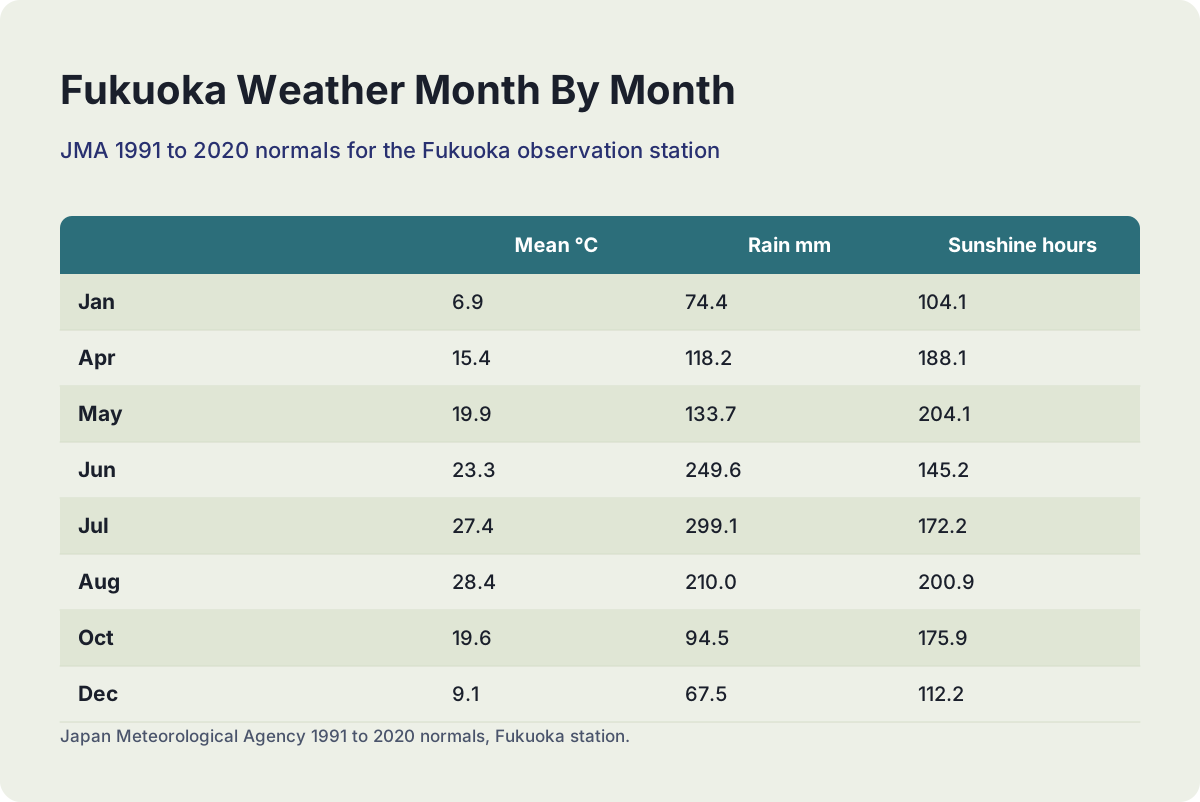
A few patterns are worth naming outright. May is the sunniest month of the year at 204.1 hours, edging out August's 200.9, and it comes with comfortable 24.4°C daily highs. October delivers 175.9 sunshine hours with a 23.7°C maximum, which is close to perfect walking weather. The grey stretch is November through February, when sunshine drops to its lowest of the year, though rain eases at the same time: December's 67.5 mm is the driest month of the year.
When Is the Best Time to Visit Fukuoka for Good Weather?
The two best weather windows are late March to early May and October to mid-November. April averages 15.4°C with 188.1 sunshine hours, May 19.9°C with 204.1 hours, and October 19.6°C with 175.9 hours. Both windows come with monthly rain between 94.5 and 133.7 mm, so neither is dry, but both pair mild daytime temperatures with the year's best light. If you want one single month, May edges it.
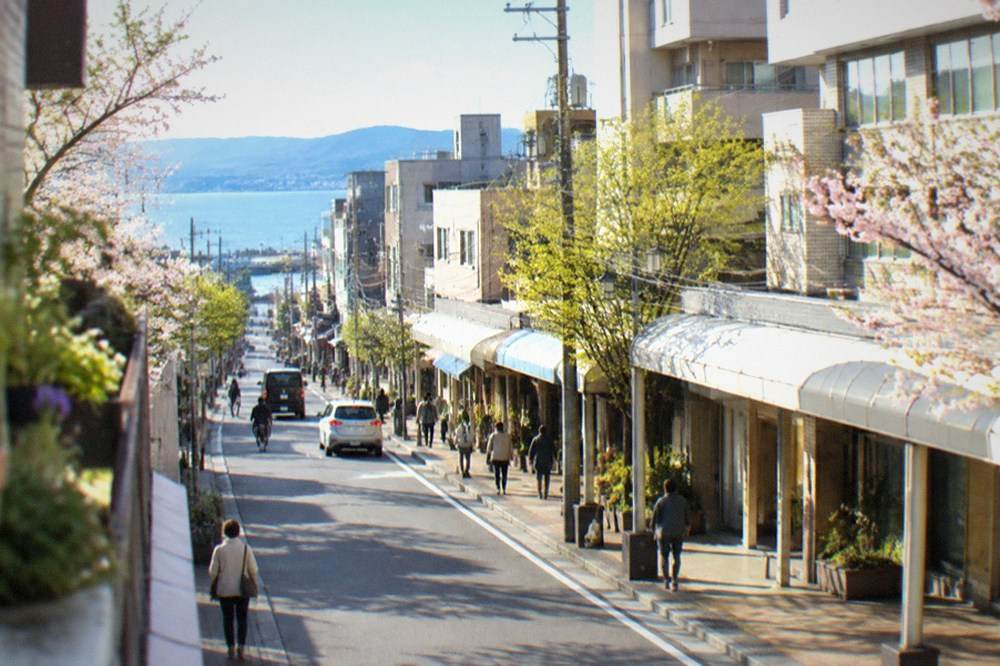
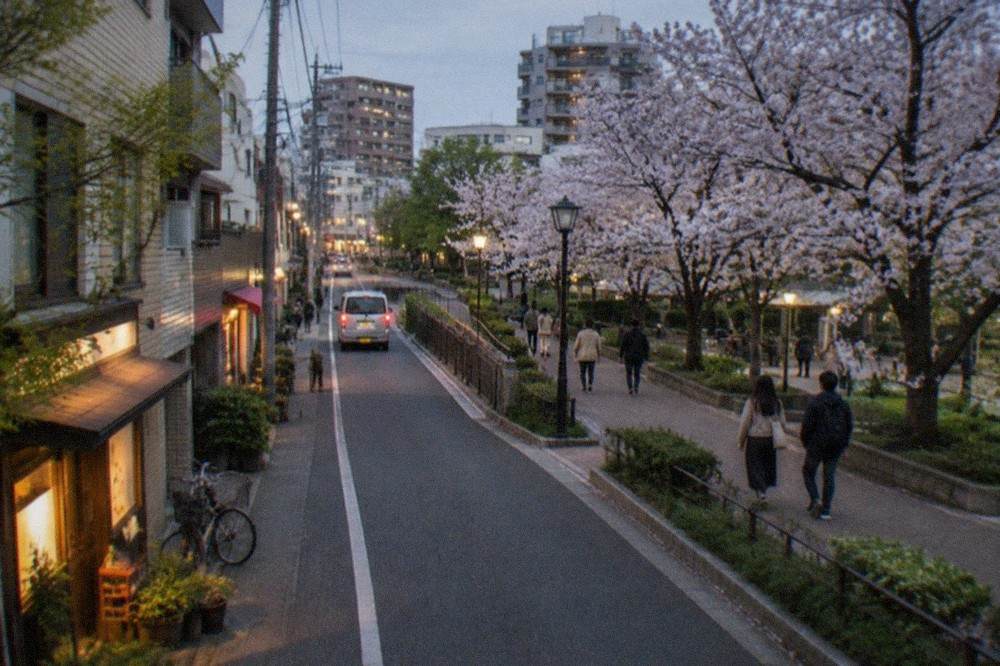
The choice between spring and autumn comes down to what you are visiting for. Spring brings the cherry blossoms: first bloom in Fukuoka typically falls in late March, with full bloom at the end of March into the first days of April, and Maizuru Park's roughly 1,000 trees are the city's signature viewing spot. Autumn brings the colour later and slower, with the mid-to-late November peak, and city parks such as Ohori and Maizuru often hold their colour into early December. Our best time to visit Fukuoka guide weighs festivals and crowds against these numbers, and the Fukuoka in autumn guide covers the leaf season in detail.
| Season | Months | Mean °C range | Rain per month | Best for |
|---|---|---|---|---|
| Spring | Mar to May | 10.8 to 19.9 | 103.7 to 133.7 mm | Cherry blossoms, mild walking weather |
| Summer | Jun to Aug | 23.3 to 28.4 | 210.0 to 299.1 mm | Festivals, yatai evenings, coastal trips |
| Autumn | Sep to Nov | 14.2 to 24.7 | 91.4 to 175.1 mm | Autumn leaves, comfortable hiking |
| Winter | Dec to Feb | 6.9 to 9.1 | 67.5 to 74.4 mm | Illuminations, hot pots, fewer crowds |
If you would rather someone else handle the planning on the ground, two formats suit the shoulder seasons well: a fully customised day with a licensed local guide, from $65 per person, rated 4.9 from 164 reviews, or a multi-departure day trip into the tea fields of Yame and Yanagawa's river boats, from $92 per person, rated 4.9 from 29 reviews.
For a deeper answer on month selection, the best month to visit Fukuoka question weighs weather against event dates, and it is worth reading before you fix your dates.
What Is the Rainy Season (Tsuyu) in Fukuoka?
Tsuyu, the East Asian rainy season, runs roughly through June in Fukuoka and brings 249.6 mm of rain across the month, the second-wettest of the year. Sunshine drops to 145.2 hours, the lowest of any month, as cloud settles in. The JMA declares the start and end dates regionally each year rather than publishing fixed calendar dates, so plan for a wet June pattern rather than a specific week.
June is grey rather than dramatic. Rain tends to arrive as long, steady spells rather than typhoon downpours, temperatures sit at a mean of 23.3°C, and humidity climbs as the month goes on. It is also, crucially, not the wettest month: July beats it by almost 50 mm. Plenty of travellers pass through Fukuoka in June and enjoy it, but you should build indoor flexibility into each day. The rainy day itinerary thinking applies here: museums, Canal City Hakata, and the covered Kawabata shopping arcade all keep you dry without costing you the day.
One honest note on wet evenings: yatai food stalls are weather-sensitive by design, and rain or strong wind closes a lot of them on any given night. If a yatai evening is a priority for your trip, the Fukuoka yatai guide explains how the stalls work and which areas cluster where, and you should keep that plan for a clear night rather than assuming one will appear.
When Is Typhoon Season in Fukuoka?
Typhoon season in Fukuoka runs roughly July through October, and it is a genuine planning factor for late-summer trips rather than a reason to avoid them. The JMA maintains a live typhoon feed covering the western Pacific, and storms that track toward Kyushu typically bring a day or two of heavy rain and disrupted transport rather than week-long disruption. September's monthly normal of 175.1 mm reflects that exposure.
The JMA publishes current storm positions and forecasts on its official typhoon feed at the JMA typhoon data service, and checking it a few days before you travel is the reliable way to know what is actually in the basin. The practical advice is simple: keep one flexible day in a September itinerary, know which of your plans are weather-dependent, and expect shinkansen and flight cancellations if a storm is scheduled to cross Kyushu. Most September visits see no typhoon at all; some see one. Neither outcome defines the month.
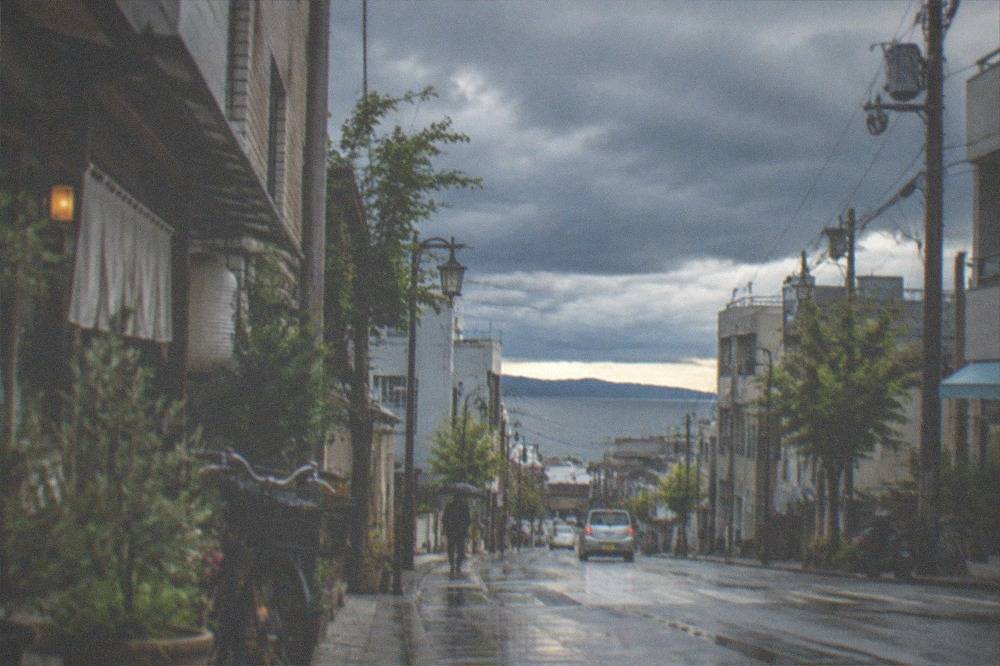
For weather-proofed alternatives on a storm-threatened day, a fully customised private tour with a licensed guide, from $160 per person for a six-hour day, rated 4.9 from 71 reviews, can be reshaped around indoor stops on short notice, which is exactly the flexibility a typhoon window rewards.
The typhoon season guide companion pages on this site cover storm-month planning in more depth if you are committed to a September or August trip and want to know how locals actually handle it.
What Is Summer in Fukuoka Actually Like?
Fukuoka summers are hot and humid: August averages 28.4°C with daily maxima of 32.5°C and overnight lows of 25.4°C, while July averages 27.4°C and peaks at 31.2°C. August is also the second-sunniest month of the year at 200.9 sunshine hours, so the heat comes with bright days rather than grey ones. Nighttime temperatures that barely fall below 25°C are the defining feature, and they shape what is comfortable and when.
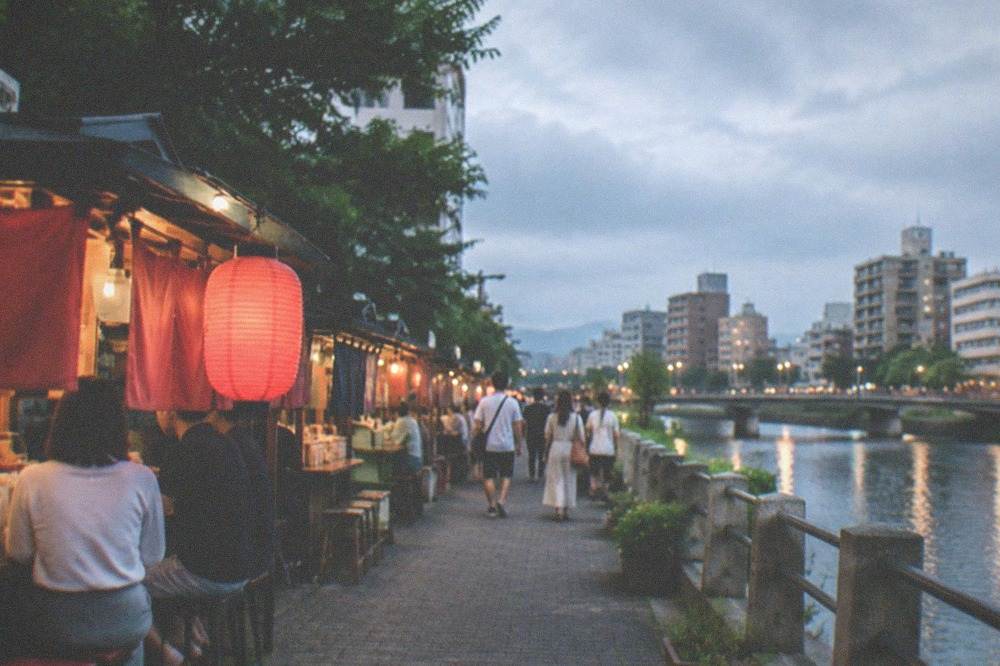
The summer rhythm in Fukuoka is built around avoiding the midday and using the evening. Locals shift meals, walks and shopping later, and the yatai stalls, which by city rules operate from late afternoon into the small hours, are the season's natural habitat. July also carries Hakata Gion Yamakasa, the festival that runs July 1 to 15 each year and culminates in the Oiyama race at 4:59 a.m. on July 15, when teams carry roughly one-tonne floats over a course of about 5 km. A 4:59 a.m. start in late July is not eccentric scheduling, it is the only tolerable hour for that effort. The Fukuoka festivals guide covers the full calendar.
| Summer month | Mean °C | Daily max °C | Night min °C | Rain mm | Sunshine hours |
|---|---|---|---|---|---|
| Jun | 23.3 | 27.2 | 20.3 | 249.6 | 145.2 |
| Jul | 27.4 | 31.2 | 24.6 | 299.1 | 172.2 |
| Aug | 28.4 | 32.5 | 25.4 | 210.0 | 200.9 |
If you are travelling in summer and want the city's evening atmosphere handled for you, an evening tour covering yatai, izakaya and karaoke runs from $99 per person, rated 5.0 from 29 reviews over 3 to 4 hours, and there is also a night views and local life tour from $100 per person for a four-hour format, a newer listing that has not yet published a rating or review count. On a hot night, a Fukuoka night itinerary route strung between stalls, river breeze and air-conditioned arcades is the comfortable shape of an evening.
Is Fukuoka's Winter Actually Cold?
Yes, Fukuoka has a real winter, but a moderate one: January averages 6.9°C with daily maxima of 10.2°C and overnight lows of 3.9°C, and it is the coolest month. December and February bracket it at 9.1°C and 7.8°C respectively. Snow is occasional rather than routine, and winter is the driest time of year, with December's 67.5 mm the lowest monthly total. Sunshine is the trade-off, at its lowest of the year.
What that feels like in practice is a jacket-and-layers winter rather than a serious-cold one. Days around 10°C are normal, and the damp maritime air can make 6°C feel sharper than the number suggests, especially in the evenings along the waterfront. This is motsunabe and tonkotsu ramen weather, and the city leans into it: hot pot restaurants, steam rising from yatai bowls, and winter illuminations are the season's core experiences. The Fukuoka in winter guide covers the full cold-season picture, and the where to stay in Fukuoka guide notes which districts keep you within a short walk of heated arcades and stations on cold nights.
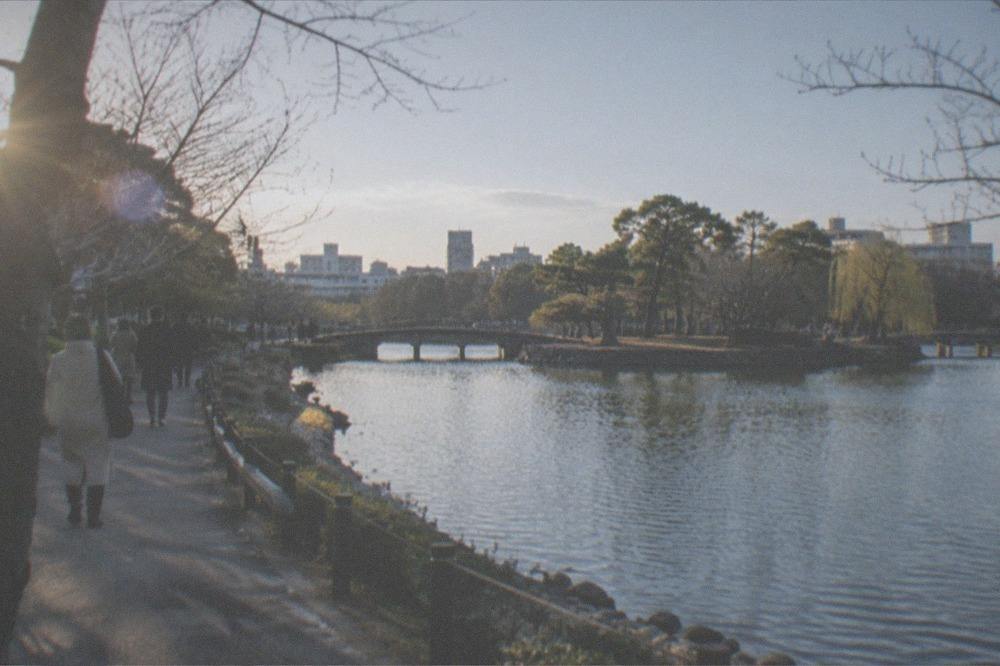
One closure worth checking if you are travelling in late 2026: the Fukuoka Castle Tenshudai, the main keep base, is closed from May 26, 2026 until the end of December 2026 for an archaeological excavation prompted by a document found in December 2024 describing a keep that may never have existed. The park grounds around it remain free and open.
What Is Spring in Fukuoka Like?
Spring moves fast in Fukuoka: March averages 10.8°C, April 15.4°C and May 19.9°C, with daily maxima climbing from 15.0°C to 24.4°C across the three months. Sunshine rises sharply from 161.2 to 204.1 hours, the year's best. Rain stays moderate at 103.7 to 133.7 mm a month. Cherry blossoms typically open in late March and reach full bloom at the end of March into early April, and the display is brief.
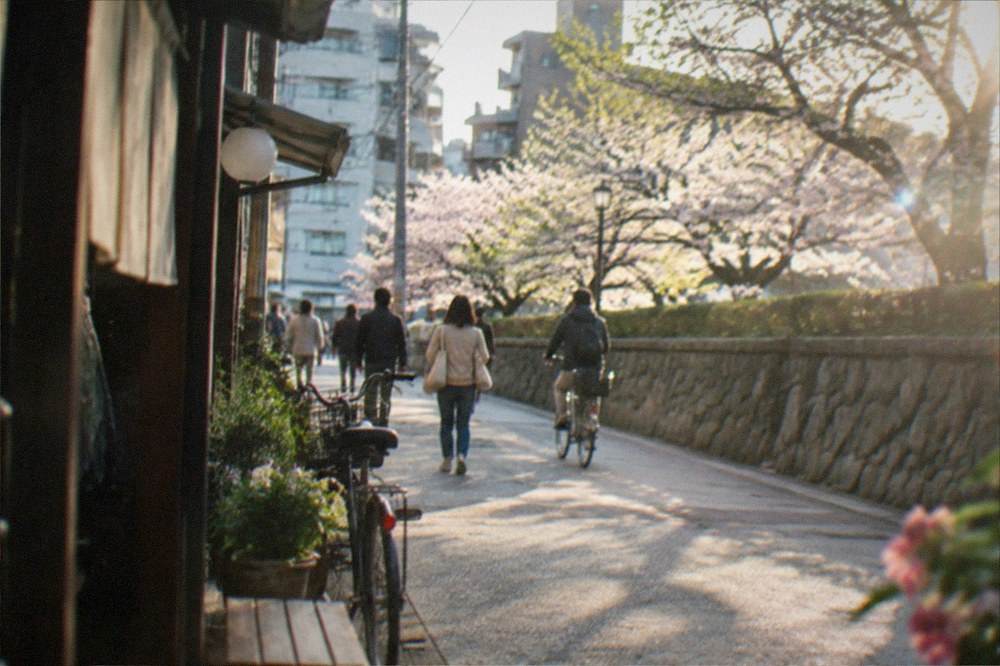
The blossom window is the compressed heart of the season, and it is weather-fragile: a warm February can pull it earlier, a cold March can hold it back, and a storm front can shorten full bloom to a matter of days. Maizuru Park at the Fukuoka Castle ruins holds roughly 1,000 trees and runs illuminations during the festival period, Nishi Park is a hillside spot counted among Japan's top 100 sakura locations, and Tenjin Central Park is the convenient city-centre option. Beyond the blossoms, May is arguably the finest month in the entire year in Fukuoka: 24.4°C days, the most sunshine of any month, and the lowest rainfall of the spring half of the year.
What Is Autumn in Fukuoka Like?
Autumn is Fukuoka's most reliable season: September still averages 24.7°C, October falls to a near-perfect 19.6°C with 23.7°C daily maxima, and November cools to 14.2°C. Rainfall drops steadily from 175.1 to 91.4 mm across the three months, and sunshine holds up well at 175.9 hours in October. Leaf colour peaks in the city's parks in mid-to-late November and often holds into early December.
Autumn rewards the traveller who missed the spring window. Where April's blossoms last days, the November colour at Ohori Park and Maizuru Park stretches over weeks, and the Dazaifu and Komyozenji area to the south peaks in mid-to-late November with a moss garden framed by maples. Temperatures in the 14 to 24°C band suit long walking days, the seafood is at its autumn best, and typhoon risk tapers through October. Dress in layers, since a mid-October morning at 16.0°C can still be a 23.7°C afternoon.
| Month | Mean °C | Daily max °C | Rain mm | Comfort notes |
|---|---|---|---|---|
| Sep | 24.7 | 28.6 | 175.1 | Warm, residual typhoon risk |
| Oct | 19.6 | 23.7 | 94.5 | Close to ideal walking weather |
| Nov | 14.2 | 18.2 | 91.4 | Layers needed, peak leaf season |
How Should You Pack for Fukuoka's Weather?
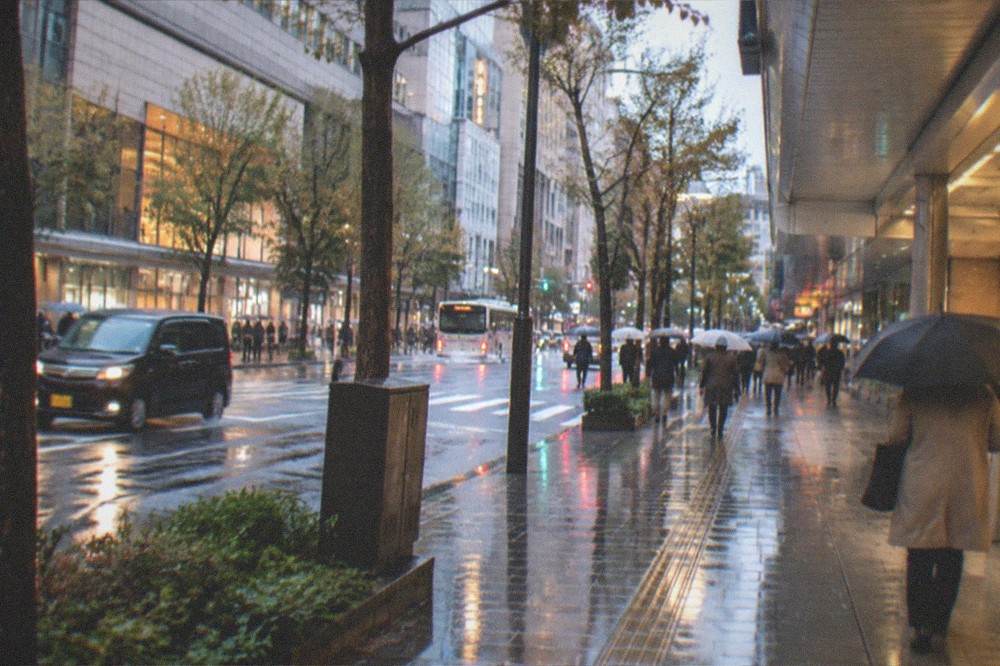
Pack for Fukuoka's humidity rather than its headline temperatures: summer trips need quick-drying clothes, a sweat towel and rain protection for 299.1 mm-class months, while winter trips need real layers for 6.9°C damp evenings. Spring and autumn are layers-plus-jacket seasons where a 15°C morning becomes a 24°C afternoon. An umbrella is worth carrying in every month of the year, since no month averages under 67.5 mm of rain.
| Season | Daytime range | What to bring | What to skip |
|---|---|---|---|
| Spring (Mar-May) | 15.0 to 24.4°C | Layers, light jacket, umbrella | Heavy coat after mid-April |
| Summer (Jun-Aug) | 27.2 to 32.5°C | Quick-dry clothes, towel, umbrella, sunscreen | Jeans, anything heavy |
| Autumn (Sep-Nov) | 18.2 to 28.6°C | Layers, warm layer for November evenings | Single thin outfit |
| Winter (Dec-Feb) | 10.2 to 12.6°C highs | Warm jacket, sweater, waterproof layer | Shorts, assumption of snow boots |
A few Fukuoka-specific notes round out the packing list. Comfortable shoes matter more here than in most Japanese cities because the good stuff, from Ohori Park's two-kilometre lake loop to the Tenjin underground shopping streets and the Hakata station area, is reached on foot or by a subway system covered in the getting around Fukuoka guide. If you are arriving from Tokyo or Osaka, the Tokyo to Fukuoka and Osaka to Fukuoka routes both land you in the same mild coastal climate, so pack once and travel light. And if a late-summer or early-autumn trip is on the cards, the evening light over the bay is the season's quiet prize: a night views and local life tour from $100 per person, a newer listing with no rating or review count published yet, runs four hours through exactly those neighbourhoods, and free cancellation is offered on the live listing.
For travellers who prefer their evenings structured around the table rather than the view, the same season pairs well with a guided food crawl, and the Fukuoka food tours overview lists the formats that suit each month, from lantern-lit stalls in July to hot pot restaurants in January. Whatever month you settle on, this site exists to help you read the weather honestly: Fukuoka Japan Travel Guide publishes the numbers, the closures and the timing questions straight from official sources, month by month.
Common Questions About Fukuoka Weather
What Is Fukuoka's Weather Like Month By Month?
Fukuoka's months run from a January mean of 6.9°C and 74.4 mm of rain, through a mild April at 15.4°C, a hot and humid August at 28.4°C, and back down to December at 9.1°C. July is the wettest month at 299.1 mm, May the sunniest at 204.1 hours, and December the driest at 67.5 mm. The annual total is 1,686.9 mm of rain, so some rain falls in every month of the year.
Is July Or June Rainier In Fukuoka?
July is rainier. The JMA 1991 to 2020 normals give July 299.1 mm against June's 249.6 mm, even though June is the tsuyu rainy season month. July combines festival crowds with the year's peak rainfall, which is worth knowing before you book a July trip around Hakata Gion Yamakasa.
Does Fukuoka Get Typhoons?
Yes. Typhoon season runs roughly July through October in northern Kyushu, and storms that track toward the region typically bring one to two days of heavy rain and some transport disruption. The JMA publishes live storm positions on its typhoon feed, and checking it a few days before travel is the reliable way to see what is actually in the basin.
Is Fukuoka Hot In Summer?
Yes, and humid with it. August averages 28.4°C with daily maxima of 32.5°C and overnight lows of 25.4°C, so nights cool barely at all. August is also the second-sunniest month of the year at 200.9 sunshine hours, so the heat arrives with bright days rather than grey ones. Plan days around mornings and evenings.
Does It Snow In Fukuoka In Winter?
Snow is occasional rather than routine. January, the coolest month, averages 6.9°C with daily maxima of 10.2°C and lows of 3.9°C, which sits mostly above freezing. Winter is the driest season, with December's 67.5 mm the lowest monthly total, though it is also the least sunny time of year.
When Is Cherry Blossom Season In Fukuoka?
Typically first bloom arrives in late March, with full bloom at the end of March into the first days of April. Maizuru Park at the Fukuoka Castle ruins, with roughly 1,000 trees, Nishi Park and Tenjin Central Park are the city's main viewing spots. The window is brief and weather-sensitive, so keep a flexible day or two in the itinerary.