Fukuoka vs Osaka
Fukuoka and Osaka are both famous for food, street culture and an easy west-of-Tokyo pace, but they suit different trips. This guide compares transport, costs, day trips, weather and atmosphere so you can pick the right one.
Short answer
Fukuoka wins on compactness, airport access and Kyushu day trips, with a ¥260 subway fare from the airport into the city. Osaka wins on sheer scale, nightlife districts and proximity to Kyoto, Nara and Kobe. Both are food cities; the honest answer depends on whether you want a walkable base or a big-city hub.
Fukuoka and Osaka get compared constantly, and for good reason. Both are western-Japan food cities with big personalities, both are friendlier to a budget than Tokyo, and both anchor a region most first-time visitors under-explore. Yet they are very different places in scale, rhythm and what sits beyond the city limits. Osaka is one of Japan's largest metropolitan areas, a dense sprawl of wards, rivers and neon that most travellers reach by Shinkansen from Tokyo or Kyoto. Fukuoka, on the northern coast of Kyushu on the Genkai Sea, is Japan's fastest-growing major city, home to 1,663,892 people at the October 2025 census count, and it packs its attractions into a far tighter footprint around Hakata Bay.
This comparison walks through the decisions that actually matter: how easy each city is to reach and move around in, what the food costs and delivers, where the day trips go, and what kind of traveller each place rewards. One point worth clearing up before anything else, because it is the single most common error in guides to this region: Hakata and Fukuoka are the same city. Hakata is the ward and the name of the main station, and there is no JR Fukuoka Station anywhere in Japan. If a plan tells you to travel "from Hakata to Fukuoka", it was written by someone who has never been. The full question, with a shorter verdict, also sits on our answers page for Osaka versus Fukuoka.
Is Osaka or Fukuoka Better?
Neither city is simply better, and the honest verdict is that Fukuoka is the easier, more compact city to visit while Osaka is the bigger, louder one with more world-famous neighbours. Fukuoka puts its airport, its food stalls, its shrine districts and its waterfront within a short subway ride of each other. Osaka trades that compactness for scale, with enormous nightlife districts and Kyoto, Nara and Kobe on its doorstep. Choose Fukuoka for a relaxed, walkable base with dramatic day trips; choose Osaka for maximum intensity and Kansai's classics.
The case for Fukuoka is convenience and character in close quarters. The city runs on a small, legible subway network, its famous yatai food stalls cluster within walking distance of the main hotel districts, and its signature dishes, tonkotsu ramen, motsunabe and mentaiko, are everywhere. About 100 licensed yatai operate across the city, more than any other Japanese city has, and a city ordinance requires every stall to post its prices openly, banning vague "market price" menus. That combination of density and transparency is rare, and it shapes the whole experience of eating there.
The case for Osaka is scale and adjacency. Dotonbori, Shinsekai and Umeda are among the most energetic entertainment districts in the country, and the city functions as a base for the Kansai region's headline sights. A traveller sleeping in Osaka can reach Kyoto, Nara, Kobe and Himeji without changing hotels. Fukuoka cannot match that roster of neighbouring classics, but its own day-trip range, Dazaifu, Yanagawa, Itoshima, Nokonoshima and the wider reaches of Kyushu, rewards a different kind of curiosity. Our guide to day trips from Fukuoka covers that spread in detail.
A useful shorthand: Osaka is a city you visit for the city itself plus its neighbours, while Fukuoka is a city you visit for its way of life plus an island most visitors never see. If your trip is a first Japan circuit built around Kyoto, Osaka is the practical base. If you have done the classics, or you want a slower, smaller, food-first city, Fukuoka delivers more ease per day.
Which City Is Easier to Reach and Get Around?
Fukuoka is the easier city to land in and navigate, because its airport sits unusually close to the centre and its three-line subway is simple to ride, with a single fare of ¥260 from the airport to Hakata Station. Osaka's Kansai Airport is far out on a man-made island in the bay, and its rail and subway network, while excellent, is far larger and demands more route planning. For a short trip, Fukuoka's compactness saves real hours.
Fukuoka Airport (FUK) is genuinely one of Japan's most convenient gateways. The subway's Kuko line runs straight from the airport into the city, and the fare to Hakata Station is ¥260 for an adult, a figure derivable directly from the operator's official 3 to 7 km fare band on the city subway fare page. What almost every competing guide prints, a journey time of five minutes, is not verified on any official page, so treat the closeness as the fact and ignore the stopwatch claim. The airport handled about 28.38 million passengers in 2025, a record year, and its second runway entered service on 20 March 2025, adding capacity at 2,500 m.
Osaka is served by two airports. Itami handles most domestic flights, while Kansai International handles international traffic and sits on an artificial island roughly an hour from the centre by train. Neither is badly connected, but both demand a longer transfer than Fukuoka's, and the city's transit map is a dense web of JR lines, the Osaka Metro and multiple private railways. It is navigable and well signed, but it is a bigger cognitive load on day one.
Inside Fukuoka, the whole useful city sits on three subway lines: Airport, Hakozaki and Nanakuma. A one-day pass costs ¥640 for an adult and covers all three lines, and single fares run from ¥210 for the shortest hops up to ¥380 for the longest. Nishitetsu trains and buses fill the gaps, and a flat central bus zone covers the Tenjin and Hakata core. Overseas visitors on short-stay visas can also buy the Fukuoka Tourist City Pass, ¥2,500 for the city version or ¥2,800 with Dazaifu included, though a passport is checked at the counter, a detail most guides still get wrong by quoting stale prices. Our guide to getting from the airport into the city covers every option.
| Transport item | Fukuoka (verified) | Osaka (general character) |
|---|---|---|
| Main international airport | FUK, unusually close to the centre | KIX, on an island roughly an hour out |
| Airport-to-centre fare | ¥260 adult subway | Higher, longer rail transfer |
| Subway lines | 3 (Airport, Hakozaki, Nanakuma) | 9 Osaka Metro lines plus JR and private rail |
| Subway day pass | ¥640 adult, ¥320 child | Comparable pass, larger network |
| Tourist city pass | ¥2,500 city / ¥2,800 with Dazaifu, passport checked | No equivalent single city pass |
| IC cards accepted | Hayakaken, nimoca, SUGOCA plus national cards | ICOCA plus national cards |
If you would rather not navigate a new subway system after a long flight, a private transfer is a reasonable splurge, especially with luggage or a late arrival. The private arrival transfer from Fukuoka International Airport to the city runs from $149 per person and takes 30 minutes to an hour, and it is rated 5 from 2 reviews on the operator's live listing.
How Do the Food Scenes Compare?
Both cities are legitimately among Japan's great eating destinations, but they express it differently: Fukuoka's food culture is street-level and personal, built around about 100 licensed yatai stalls, tonkotsu ramen and motsunabe, while Osaka's is larger-than-life and restaurant-scaled, famous for takoyaki, okonomiyaki and kushikatsu. Fukuoka is the better city for eating at counters next to strangers; Osaka is the better city for loud, indulgent food halls and snack-and-walk grazing.
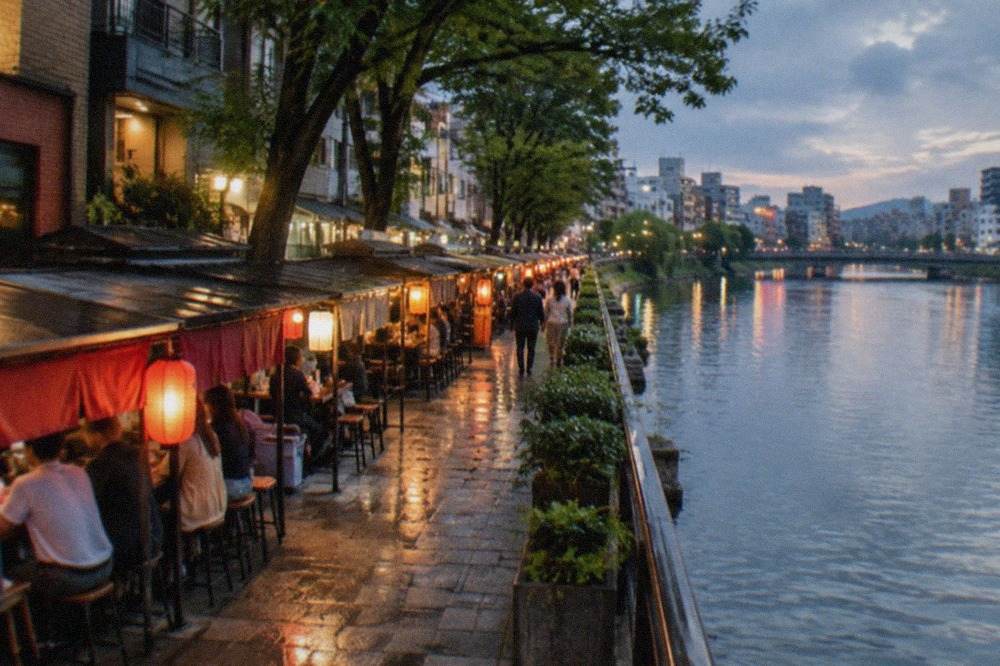
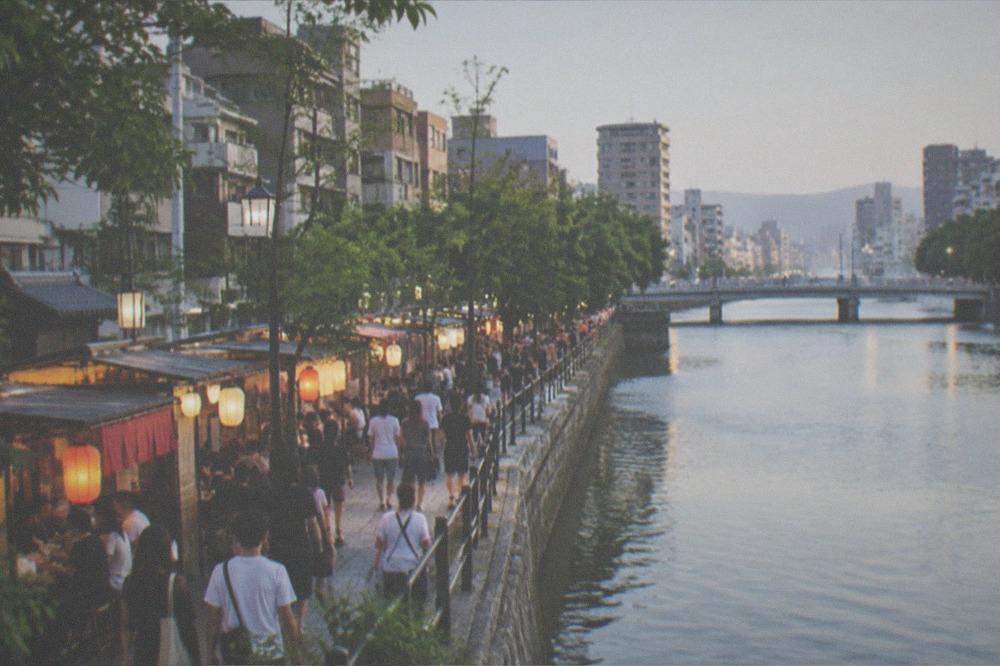
Fukuoka's defining food experience is the yatai, the licensed street stall that sets up from around 17:00 and serves until the small hours. The stalls cluster in three main areas: Nakasu along the Naka River, the photogenic row that appears on every postcard; Tenjin, scattered through the business district with a more after-work local crowd; and Nagahama, historically the ramen row near the old fish market. The city's yatai ordinance, in force since 2013, requires prices to be displayed where customers can easily see them and bans dishes being listed as market price, so the menu you read is the bill you pay. You cannot book a stall, they take walk-ins only, and rain closes many of them, so plan a flexible evening. Our guide to Fukuoka's yatai covers etiquette and what to order.
Osaka's food fame rests on its street snacks and its self-image as the nation's kitchen. Takoyaki balls, folded okonomiyaki pancakes and skewered kushikatsu are sold everywhere from Dotonbori's neon canyon to neighbourhood corners, and the eating style is fast, cheap and social. Osaka also has a deeper fine-dining and department-store food-hall layer than Fukuoka, a function of its size. What it does not have is the yatai institution; the intimate counter conversation with a stall owner is a Fukuoka thing specifically.
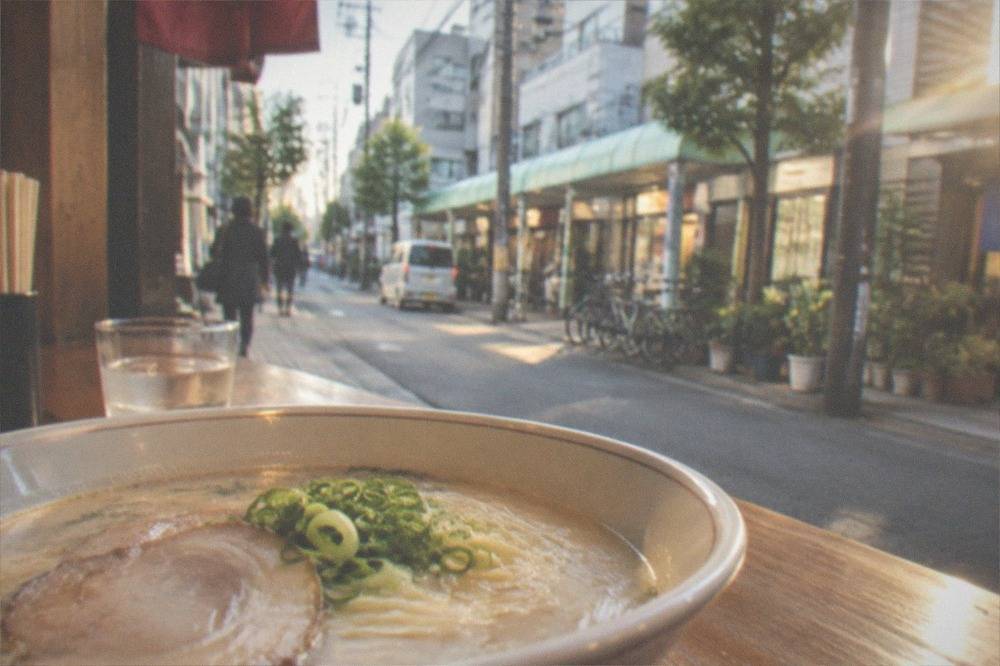
For ramen, the comparison is decisive in Fukuoka's favour. Hakata ramen, the rich tonkotsu pork-bone broth served with thin noodles and the famous kaedama refill system, was born in this city, and the standard is uniformly high. Osaka's ramen culture exists but is not its signature. Conversely, Osaka's takoyaki has no true Fukuoka equivalent. A fair reading is that Fukuoka's food scene is narrower but deeper in its specialties, while Osaka's is broader and more theatrical. The wider Fukuoka food guide maps the full menu.
A guided crawl is the efficient way to eat either city on a short visit. In Fukuoka, the Nakasu food stall private guided tour with tastings runs from $94 per person, is rated 4.7 from 70 reviews and lasts about two hours, which is enough to hit several stalls with a local steering you past the tourist traps.
How Do Prices Compare?
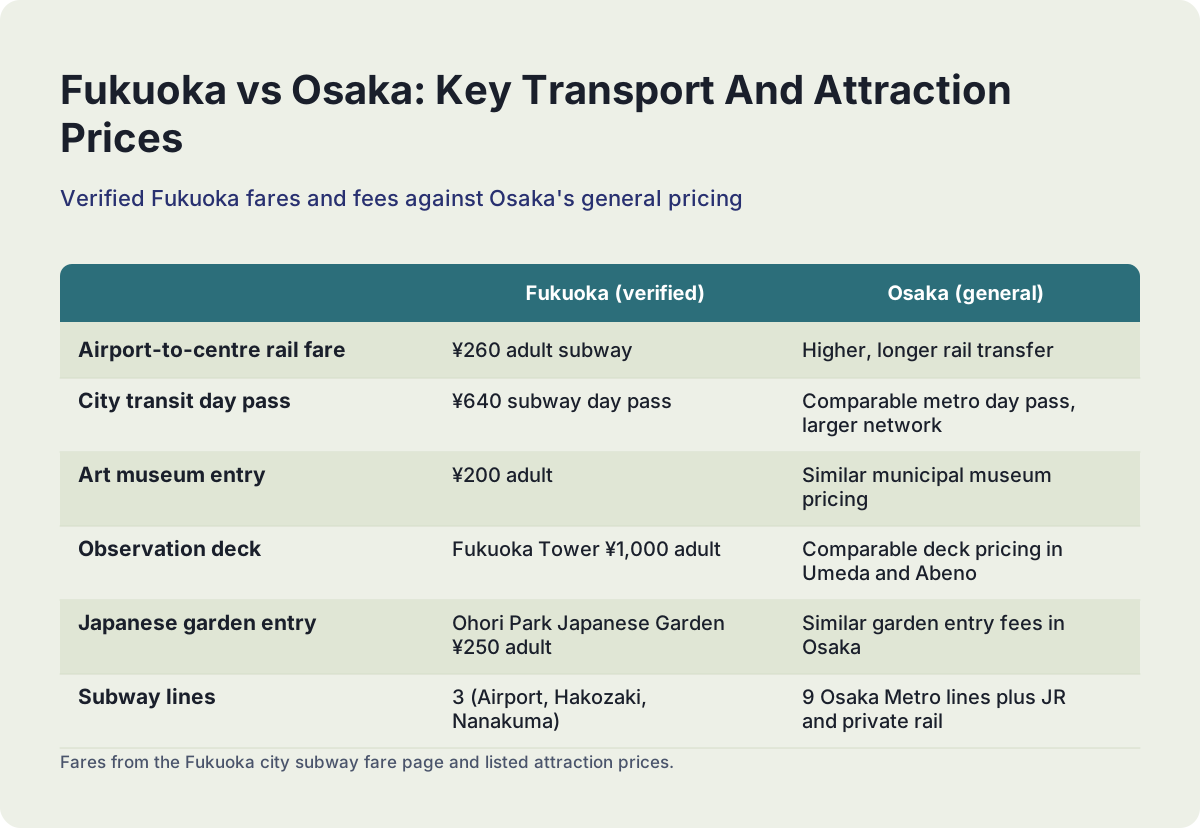
Fukuoka is generally the cheaper city to visit, with lower hotel rates, cheaper subway fares and inexpensive food stalls, though the gap narrows once you book mid-range hotels in either city. Fukuoka's verified transport numbers, a ¥260 airport subway fare and a ¥640 day pass, are hard to beat, and its museums charge around ¥200 for adults. Osaka's costs are not punishing either, but its bigger hotel market and tourist-core pricing push the average trip budget higher.
Neither city is expensive by Japanese standards, and both undercut Tokyo on almost everything. The differences are at the margins, but the margins add up over a week. The table below compares typical verified Fukuoka figures with the general character of Osaka pricing, and the honest caveat is that this site's verified fact pack covers Fukuoka in depth, so Osaka entries are qualitative rather than sourced numbers.
| Cost item | Fukuoka (verified) | Osaka (general character) |
|---|---|---|
| Airport-to-centre rail fare | ¥260 adult subway | Higher, longer distance from Kansai Airport |
| City transit day pass | ¥640 subway day pass | Comparable metro day pass, larger network |
| Art museum entry | ¥200 adult at both city art museums | Similar municipal museum pricing |
| Observation deck | Fukuoka Tower ¥1,000 adult | Comparable deck pricing in Umeda and Abeno |
| Street food meal | Yatai dishes with posted prices, ordinance-enforced | Takoyaki and kushikatsu, cheap and everywhere |
| Japanese garden entry | Ohori Park Japanese Garden ¥250 adult | Similar garden entry fees in Osaka |
Attraction costs in Fukuoka are notably gentle. Fukuoka Tower charges ¥1,000 for adults, ¥500 for elementary and junior high students and ¥200 for children aged four and over, with observation decks at 123 m, 120 m and 116 m of its 234 m height. Both city art museums charge ¥200 for adults and ¥150 for high school and university students, with free entry for junior high and younger, and free entry for residents over 65 from Fukuoka and several neighbouring cities. Dazaifu Tenmangu, the region's most famous shrine, charges no entrance fee at all, a fact stated explicitly on the shrine's own FAQ page at the official Dazaifu Tenmangu site.
Accommodation is where the real difference lives. Fukuoka's hotel stock concentrates around Hakata Station and Tenjin, and rates tend to sit below Osaka's, especially in the business-hotel category. Osaka's pricing swings harder around events and holidays because demand is larger. If budget is the deciding factor, Fukuoka stretches further without any drop in food quality, and our guide to where to stay in Fukuoka breaks the districts down.
Which City Has Better Day Trips?
Osaka has the more famous day trips, with Kyoto, Nara, Kobe and Himeji all within easy reach, while Fukuoka has the more surprising ones, reaching Dazaifu, Yanagawa, Itoshima and Nokonoshima easily, and Yufuin, Beppu, Mount Aso, Takachiho, Kumamoto and Nagasaki as full days. If your list is Japan's classic sights, Osaka wins. If you want places your friends have not already photographed, Fukuoka wins.
Osaka's day-trip roster is the strongest in the country, and no honest comparison hides that. Kyoto's temples, Nara's deer and the Great Buddha, Kobe's harbourfront and Himeji's castle are all under an hour or so by train. The trade-off is that everyone else has the same plan, and the classic circuit is crowded in every peak season. Osaka functions less as a destination in itself for many travellers than as the logistics hub for Kansai. The wider set of guides lives on Fukuoka Japan Travel Guide.
Fukuoka's day trips split into two tiers. The near ones, Dazaifu with Tenmangu shrine, the canal town of Yanagawa, the Itoshima coast and the island of Nokonoshima, are half-day to short-full-day trips on local trains, buses and ferries. The far ones, Yufuin, Beppu, Mount Aso, Takachiho Gorge, Kumamoto and Nagasaki, are full days by tour bus or rail, and they should never be sold as half-days. The Itoshima hidden gems day tour runs from $69 per person, is rated 4.6 from 31 reviews and lasts 8 hours 30 minutes, a fair sample of the coastal option. Our Itoshima day trip guide and the wider Kyushu guide map the rest.
The character difference matters more than the count. Kansai's classics are urban and architectural; Kyushu's are volcanic, coastal and rural. A day trip from Fukuoka can put you at a smoking volcano's rim, a gorge with a boat ride, or a fishing-village lunch that has no English menu. A day trip from Osaka puts you in front of some of the most significant buildings in Japan. Both are excellent; they are simply different trips, and a traveller torn between the two regions can reasonably build a route that includes both.
What About Weather and the Best Time to Visit?
Both cities share hot, humid summers and mild winters, but Fukuoka's climate is measurably wetter in July than in June, which surprises most travellers: Japan Meteorological Agency normals show 299.1 mm of July rain against 249.6 mm in June, even though June is the tsuyu rainy season. Osaka runs a similar pattern with slightly less summer rainfall. The best months in both are October to November and late March to April.
The Fukuoka figures come from the Japan Meteorological Agency's 1991 to 2020 normals for the Fukuoka observation station, published at the JMA climate statistics page. July's mean temperature is 27.4°C, rising to 28.4°C in August, and August is actually drier than both June and July while banking 200.9 sunshine hours, the second sunniest month after May. The practical lesson is that a July visit should be planned around indoor mornings and festival evenings rather than written off, because July is also Yamakasa month, when the city stages its most famous festival from 1 to 15 July, with the Oiyama race finishing at 4:59 a.m. on the 15th.
Winters are mild in both cities by Japanese standards. Fukuoka's January mean is 6.9°C with a daily minimum around 3.9°C, and snow is rare and light. Autumn is the most reliable season in both places: October and November combine comfortable temperatures with falling rain, and Fukuoka's autumn colour peaks from mid to late November into early December in the city parks. Cherry blossoms open in Fukuoka in late March and typically reach full bloom between the end of March and the first days of April. Our best time to visit guide and the month-by-month weather guide carry the full breakdown.
Typhoon season runs roughly July through October in both regions and is a genuine planning factor, though neither city is regularly disabled by it. The honest advice is to build a flexible day or two into any late-summer itinerary and to check the forecast rather than to avoid the season entirely. Both cities offer enough indoor cover, museums, malls, markets and cooking classes, to survive a wet day without losing the trip.
| Season | Fukuoka | Osaka |
|---|---|---|
| Late March to April | Cherry blossoms, mild, popular | Same blossom window, larger crowds at parks |
| June | Tsuyu rains, 249.6 mm | Rainy season, marginally less rain |
| July | Wettest month, 299.1 mm, Yamakasa festival | Hot, humid, festival season |
| August | Hottest month, 28.4°C mean, drier | Peak heat, fireworks season |
| October to November | Most reliable weather, autumn colour | Same, excellent for walking districts |
| December to February | Mild, around 7°C January mean | Similar, slightly cooler inland |
Which City Wins for Nightlife and Festivals?
Osaka has the bigger and more famous nightlife, with Dotonbori, Shinsekai and Umeda running late and loud, while Fukuoka has the more distinctive version, centred on yatai stalls, the Nakasu riverside and a compact bar scene you can walk home from. In festivals, Fukuoka's Hakata Gion Yamakasa and Hakata Dontaku draw crowds in the millions, while Osaka's Tenjin Matsuri is one of Japan's three great festivals. Both are strong; Osaka is louder, Fukuoka is more atmospheric.
Fukuoka's nightlife is unusually concentrated. Nakasu, the entertainment district between the Naka River and the Hakata station area, holds the riverside yatai row, the Nakasu Jazz festival each September and a dense strip of bars and izakaya, all walkable from the main hotel zones. The stalls themselves are the evening institution: setup is permitted from 17:00, most open around 18:00 to 18:30, and they run into the small hours, weather permitting. There is no city-mandated closing night, so any evening is possible and rain is the real variable. Our Fukuoka nightlife guide covers the districts beyond the stalls.
Osaka's nightlife needs no introduction because Dotonbori's Glico sign is one of the most photographed corners of Japan. The scale is simply larger: more bars, more late dining, more neon, and a street-snacking culture that runs all night in the tourist core. If nightlife volume is the priority, Osaka wins on weight of numbers. What Fukuoka offers instead is intimacy, the chance to eat at a seven-seat stall beside a local who wants to know where you are from, which Osaka's mega-districts rarely reproduce.
Festivals are closer than the nightlife comparison. Fukuoka's Hakata Gion Yamakasa runs 1 to 15 July every year, centred on Kushida Shrine, with decorated floats on display from the 1st and the Oiyama race on the 15th, when teams carry floats weighing around a ton over a roughly 5 km course. Hakata Dontaku fills Meiji-dori on 3 and 4 May with parades and costumed performers. Neither has any ticketing at all; you simply show up. Osaka's Tenjin Matsuri in July is counted among Japan's three great festivals, with a river procession and fireworks. A traveller who times either city's festival right gets one of the best free spectacles in the country.
For a guided evening, Fukuoka's evening tours combining yatai, izakaya and karaoke run from $99 per person and are rated 5 from 29 reviews, while the half-day city essentials tour, from $74 and rated 4.9 from 48 reviews, suits a daytime orientation before you head out on your own.
Which Is Better for Families and First-Timers?
Fukuoka is the gentler introduction to Japan: a smaller city, shorter transfers, cheap and simple transit, and child-friendly attractions like Uminonakamichi Seaside Park, Marine World and the city zoo within easy reach. Osaka works well for families too, with Universal Studios Japan as its ace, but the city's size makes each outing a bigger expedition. For a first trip that includes Kyoto, Osaka is the logical base; for a first trip on its own, Fukuoka is less work.
Fukuoka's family credentials are practical rather than spectacular. Uminonakamichi Seaside Park, out on the sandbar across Hakata Bay, charges ¥450 for adults and is free for junior high and younger, with one genuinely useful quirk: the park gate takes cash only, which almost no guide mentions. Marine World Uminonakamichi, the adjacent aquarium, charges ¥2,500 for adults and ¥1,200 for elementary and junior high ages. The city zoo charges ¥600 for adults and is free for junior high and under. None of these require a car; the subway and a short ferry or bus ride cover them. Our Fukuoka with kids guide builds full days around them.
Osaka's family trump card is Universal Studios Japan, which no Kyushu city can match, plus the Osaka Aquarium Kaiyukan and the Expo Park area. The trade is logistics: each of those sits at the end of a longer transit ride, and the city's scale means a family covers more distance per attraction. Families combining Osaka with Kyoto and Nara get an itinerary that practically writes itself, but it is a busier trip.
For first-time visitors to Japan generally, the decision usually follows the wider route. If the trip is the classic golden route extended west, Osaka slots in naturally between Kyoto and Hiroshima, and our Osaka to Fukuoka guide covers the onward leg. If the trip is Kyushu-focused or a standalone city break, Fukuoka's airport proximity and compact centre remove most first-visit friction.
So Which Should You Choose?
Choose Fukuoka if you want a compact, walkable food city with an airport minutes from the centre, honest street-stall dining, mild winters and day trips into volcanic Kyushu; choose Osaka if you want maximum urban energy, world-class nightlife districts and the classic Kansai circuit of Kyoto, Nara and Kobe within commuting distance. The two cities are not really rivals: Osaka is a hub, Fukuoka is a destination, and the right pick depends on the trip you are building around it.
A few traveller profiles make the decision easy. You should lean Fukuoka if you are eating your way through the trip, if you have already done Kyoto and Tokyo, if you are travelling with children and want short transfers, or if you are on a two- or three-day city break where transit friction eats a real share of the visit. The verified numbers support that case: a ¥260 airport fare, a ¥640 day pass, ¥200 museum entry and a ¥1,000 tower ticket make Fukuoka one of the lowest-friction cities in Japan.
You should lean Osaka if this is a first Japan trip built around the famous sights, if nightlife volume matters, if Universal Studios Japan is on the list, or if you simply want more city per day than anywhere else in western Japan. Osaka is not a compromise choice; it is the correct base for a Kansai circuit, and its food culture fully earns its reputation.
There is also the honest third answer: many travellers do both. The Shinkansen and flights connect the two cities routinely, and a Kansai-plus-Kyushu route is one of the best two-week trips in the country. If you are weighing where to sleep once you have chosen Fukuoka itself, the Hakata versus Tenjin question settles it district by district.
Whichever you pick, book the two or three things that genuinely need booking, the tours and transfers, and leave the rest to the city. Fukuoka rewards the unplanned evening at a stall; Osaka rewards the unplanned detour into a side street off Dotonbori. Both cities are at their best when the itinerary leaves room for exactly that.
Common Questions About Fukuoka vs Osaka
Is Osaka Or Fukuoka Better?
Fukuoka is better for a compact, food-first visit with easy airport access and Kyushu day trips; Osaka is better for big-city nightlife and combining Kyoto, Nara and Kobe. Neither is objectively superior, they serve different itineraries.
Is Fukuoka cheaper than Osaka?
Generally yes, modestly. Fukuoka's verified transit costs, a ¥260 airport subway fare and a ¥640 day pass, plus ¥200 museum entry and low street-food prices, keep a budget lower, though mid-range hotel rates in the two cities are closer than the transit gap suggests.
Which city has better food?
Both are top-tier food cities. Fukuoka is stronger for tonkotsu ramen, motsunabe and the yatai stall experience, with about 100 licensed stalls required by city ordinance to post their prices. Osaka is stronger for takoyaki, okonomiyaki and sheer variety at scale.
Which has better day trips?
Osaka, for famous sights: Kyoto, Nara, Kobe and Himeji are all short train rides away. Fukuoka, for unusual ones: Dazaifu, Yanagawa, Itoshima and Nokonoshima nearby, and Yufuin, Beppu, Mount Aso, Takachiho, Kumamoto and Nagasaki as full days.
Is Fukuoka's airport really close to the city?
Yes, unusually close, and that is officially sourced. The subway fare from the airport to Hakata Station is ¥260. The widely repeated "five minutes" journey time is not verified on any official page, so treat the closeness as the fact rather than the stopwatch claim.
When is the best time to visit either city?
October to November is the most reliable window in both, with mild weather and autumn colour. Late March to early April brings cherry blossoms. Note that July is Fukuoka's wettest month, 299.1 mm against June's 249.6 mm, despite June being the rainy season.