Michelin Restaurants in Fukuoka
Fukuoka's food reputation rests on yatai stalls and tonkotsu ramen, but the city also holds places in the Michelin Guide's Kyushu selections, and those tables are the hardest reservations in the city to land. Here is how the booking mechanics actually work, how far ahead to try, and what the honest fallbacks are.
Short answer
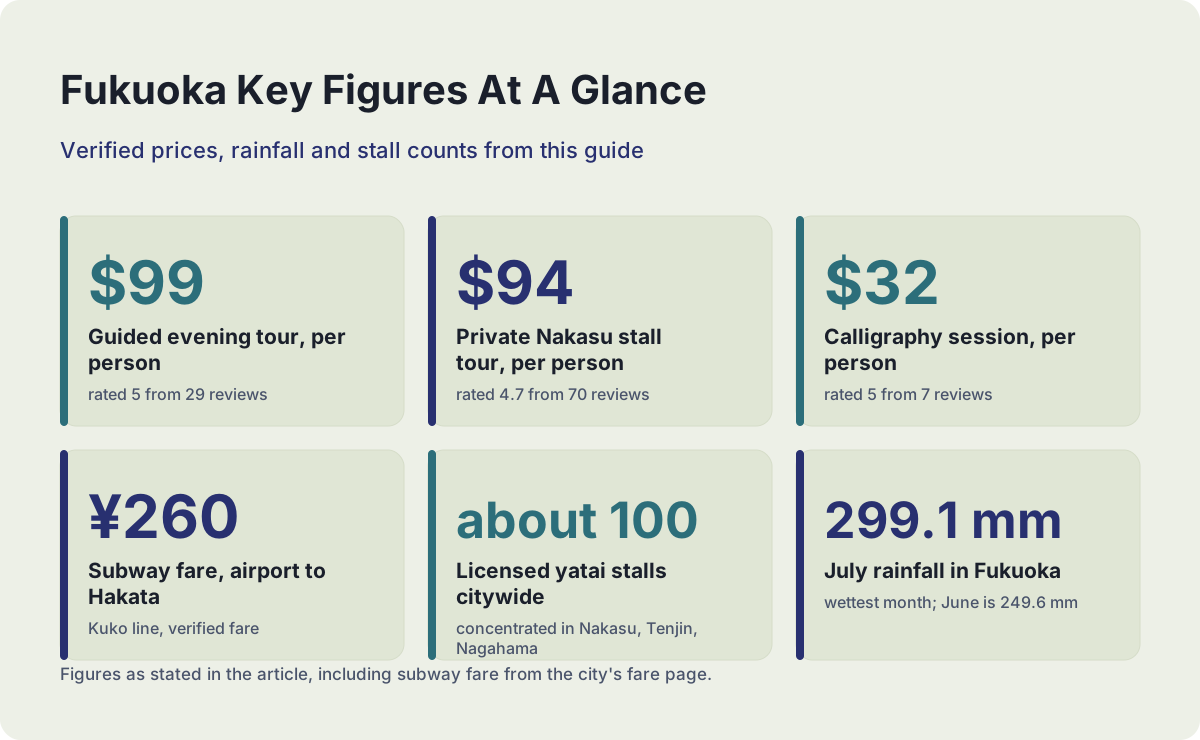
For a Michelin-listed counter in Fukuoka, start trying one to three months ahead, the moment your travel dates firm up. Small counters release seats in monthly batches, hotel concierges and reservation services can reach tables you cannot, and same-week cancellations do happen. If the booking fails, the yatai scene, about 100 licensed stalls citywide, is the fallback Fukuoka is actually famous for.
Fukuoka is one of Japan's great eating cities, and most of its fame was built at low counters and riverside stalls rather than behind velvet ropes. Tonkotsu ramen, motsunabe, mentaiko and the yatai stalls themselves are the dishes and venues people cross the country for. But the city also appears in the Michelin Guide's Kyushu selections, and those rooms are small, counter-driven and booked far ahead, which catches visitors off guard. A traveller who plans the ramen crawl but forgets the fine-dining reservation is a common Fukuoka pattern, and this page exists to stop it.
The honest starting point: almost nothing about Michelin booking in Fukuoka is published in a tidy way. The guide itself does not print lead times, individual restaurants set their own release schedules, and the small counter format that dominates high-end Japanese dining means a room may hold fewer seats than a family car holds passengers. What follows is the practical mechanics, written plainly, with the verified Fukuoka facts this site has checked woven in where they help.
How Far in Advance Should You Book a Michelin Restaurant in Fukuoka?
Treat one to three months as your working window, and open your attempt the day your flights are confirmed. Counter restaurants in Japan typically release seats in monthly batches rather than rolling availability, so a booking that opens on the first of the month for the following month can be gone within the hour. Same-week success happens, but only through cancellations, hotel concierges or lunch seatings, and building your plan around luck is the single most common way visitors leave Fukuoka without the meal they wanted.
The monthly-batch system is the thing most visitors from North America and Europe underestimate. In those markets a restaurant two months out looks wide open and a restaurant two weeks out looks hopeful. In Japan the calendar often simply does not exist yet: the restaurant has not released those dates, so the online booking page shows nothing, which reads as "full" to an overseas visitor when it actually means "not on sale". Checking back on the first day or two of each month, at Japanese lunchtime, is the habit that gets tables.
Counter size is the second factor. Fukuoka's high-end dining leans toward small counters rather than dining rooms, and a ten-seat counter serving one seating a night is selling seventy covers a week. A party of four is structurally harder than a party of two everywhere in this segment, and a solo or pair traveller who is flexible on date and time has a genuine advantage. If you are four people, be ready to split across two seatings or accept an earlier time.
Seasonality moves the window too. Fukuoka's peak inbound travel periods compress an already tiny inventory. Cherry blossom season, roughly late March into early April, and the autumn colour window from mid to late November are when every visitor in the city wants the same reservations. If your trip lands in either window, add a month to your lead time and start at the ninety-day mark rather than the sixty-day mark.
A practical sequence looks like this: confirm flights, identify two or three target restaurants rather than one, note each one's reservation channel, and set calendar reminders for the first of each month. Keep a backup target that is easier to book, and keep the yatai scene as the plan you would genuinely enjoy anyway. Fukuoka is unusual in that its fallback dining is world-famous in its own right, which takes a lot of the sting out of a failed booking.
What Does the Michelin Guide Actually Cover in Fukuoka?
The guide's Kyushu selections include Fukuoka restaurants across several categories, not only the starred rooms most people imagine: Bib Gourmand value picks and listed establishments sit alongside them, and the Bib tier is often the smarter target for a short trip because those tables are easier to get and the cooking is the same city's cooking. Treat the guide as a shortlist of kitchens worth booking, not a ranking of rooms you must conquer.
This site does not republish the guide's selections, because they change on the guide's own announcement cycle and a travel page that prints a list is wrong the moment the list moves. What stays stable is the pattern: Fukuoka's recognised kitchens concentrate around Hakata, Tenjin and Daimyo, the walkable central wards where the city's restaurant density is highest, and the formats skew small. Kaiseki and sushi counters, focused single-dish specialists, and modern rooms doing Kyushu produce with French or Japanese technique make up the bulk of the scene.
The Bib Gourmand tier deserves a special word for value travellers. It exists to flag good cooking at moderate prices, and in Fukuoka it overlaps heavily with the food the city already loves: ramen, udon, grilled chicken, the dishes that made Hakata a food destination before any guide arrived. A visitor who books one starred counter and fills the rest of the week from the value tier eats extremely well and spends a fraction of what a week of starred dinners would cost.
One more honest note: the Michelin label is not the only quality signal in this city, and in Fukuoka it is arguably not even the strongest one. The yatai stalls, about 100 of them under city licence, are a dining institution no guide needed to invent, and the city's own ordinance requires every stall to display its prices openly, with no vague "market price" items permitted. That price transparency is enforced, inspected, and a better consumer protection than most fine-dining markets offer. A trip built entirely around the guide misses the food Fukuoka is actually famous for, which is why this page keeps pulling back toward the stalls.
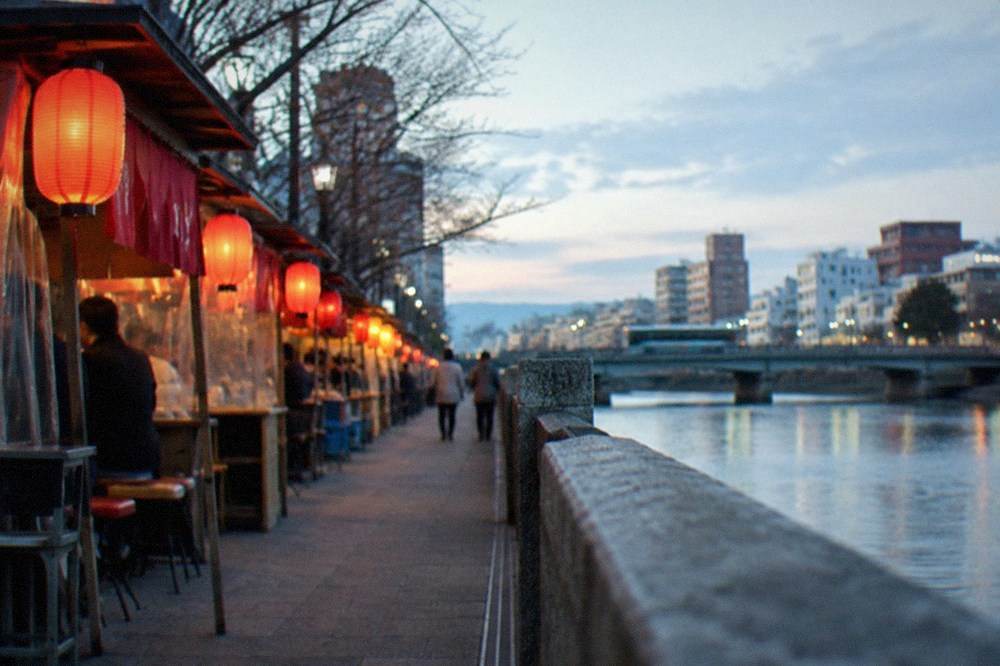
If you want the starred-counter experience and the local-stall experience in one stay, the pairing is easy in this city because the geography cooperates. The central wards are compact, the subway is cheap, and an evening that starts at a counter in Tenjin can end at a stall in Nakasu on foot. The Fukuoka food guide maps the neighbourhoods dish by dish, and the best time to visit Fukuoka page helps if your dates are still flexible and you want to dodge the busiest booking windows.
How to Actually Book: Channels That Work in Japan
Use four channels in parallel rather than one in sequence: the restaurant's own online reservation page, your hotel concierge, a paid reservation service, and the phone. The concierge route is the most underrated for Fukuoka, because a concierge in a Hakata or Tenjin hotel speaks the language, knows the release calendars and can chase a cancellation in a way an overseas email never will. Book your hotel first, then email the concierge before you arrive.
The restaurant's own page comes first because it is the only source of truth about release timing. Some counters open the next month's calendar on a fixed day, some use a first-come form on the first of the month, and some take requests by phone only. Check the page in Japanese as well as English if you can, because the Japanese page is sometimes updated first and occasionally carries different instructions. Note the cancellation policy while you are there: high-end counters in Japan commonly charge a no-show fee, and some take a card guarantee at booking, so a careless double-booking costs real money.
The hotel concierge is the channel that changes outcomes. Concierges in Fukuoka's larger hotels make these calls daily, they know which rooms answer the phone and which only take regulars, and a request from a guest in-house carries weight. Email the concierge as soon as your booking is confirmed, name your dates, your party size and any dietary needs, and ask them to try the moment the calendar opens. This costs you nothing beyond the room you were already booking, which is why it is the highest-value move in the whole process.
Paid reservation services and phone calls fill the remaining gap. Services exist that book Japanese restaurants on a traveller's behalf for a fee, and they are worth it for a once-a-trip counter when you cannot watch a calendar at Japanese office hours. The phone still works for rooms that never went digital at all, and a Japanese-speaking friend, guide or hotel front desk making that call succeeds where an English email goes unanswered. The one channel that reliably fails is the walk-in: high-end counters in this city are reservation-first, and arriving at the door is not a strategy.
| Channel | Best for | Typical timing | Honest limitation |
|---|---|---|---|
| Restaurant's own booking page | Knowing the real release calendar | Check from 2 to 3 months out, revisit on the 1st of each month | Often Japanese-only, batches sell out fast |
| Hotel concierge | Small counters, cancellations, language | Email as soon as hotel is booked | Needs a hotel with an active concierge desk |
| Paid reservation service | One key dinner, overseas time zones | Any time, fee per booking | Adds cost, still bound by availability |
| Phone | Rooms that never went digital | Japanese business hours | Requires Japanese, low success for new customers |
| Walk-in | Nothing in this segment | Same day | High-end counters are reservation-first |
Whatever channel wins, build your evening around the Fukuoka nightlife options nearby rather than racing across the city after dessert. Nakasu and Daimyo are both a short subway ride from the central restaurant zones, and the subway runs until late, so a counter dinner in Tenjin can flow straight into the bar streets without a taxi.
If You Cannot Get a Table: Yatai, Izakaya and Guided Evenings
The fallback in Fukuoka is not a consolation prize, it is the reason many people come: about 100 licensed yatai stalls operate across the city, concentrated in Nakasu, Tenjin and Nagahama, and the city ordinance requires every stall to post its prices openly where customers can see them, with market-price wording banned. No reservation is needed for a stall, and a guided evening tour can walk you straight into seats at the busiest ones.
That price-posting rule is worth pausing on, because it answers the question every first-time visitor quietly has: will I be overcharged at a stall? The city's yatai ordinance, in force since 2013, requires prices to be displayed clearly and forbids the vague "market price" label on variable dishes, and the city's own yatai Q&A confirms the city checks compliance periodically. It is one of the most consumer-friendly street-food regimes in Japan, and almost no guide mentions it. The honest answer to "is a yatai expensive" is therefore: you will know what everything costs before you order, which is more than most fine-dining tasting menus tell you upfront.
The stalls take walk-ins, full stop. You cannot book a yatai, and any page implying you need a reservation to eat at one is wrong. What you can book is a guided crawl: the roster on this site includes a guided evening tour covering yatai, izakaya and karaoke, from $99 per person, rated 5 from 29 reviews, running three to four hours, and a private Nakasu stall tour with tastings, from $94 per person, rated 4.7 from 70 reviews. A guide matters most at the famous Nakasu riverside row, where the photogenic stalls fill first on any dry evening. The full index of guides sits on Fukuoka Japan Travel Guide.
Stalls are weather-sensitive, and that is the honest caveat. Rain or strong wind closes a lot of them, because the ordinance permits occupancy from 17:00 to 04:00 but does not require anyone to open. There is no city-mandated closing day, so a stall that was closed Tuesday may be open Wednesday. The practical move is to walk the row, see what is lit, and move on; the Fukuoka yatai guide covers the three areas and their characters in detail, and the Fukuoka food tours page lists the bookable crawls if you would rather have someone else read the row for you.
Izakaya fill the gap between the counter and the stall. Daimyo and its lanes are dense with small drinking kitchens that take walk-ins early in the evening, and a failed Michelin booking converted into an izakaya crawl with a guide is, in this city, a genuinely good outcome rather than a compromise. The evening tour above exists precisely for that scenario, and its karaoke finish is a very Fukuoka way to end a night that started with a cancellation.
Timing the Booking Around Your Trip
Book the restaurant first, then build the day around it, not the reverse. A confirmed counter dinner is the least movable item in a Fukuoka itinerary, so anchor it, then arrange the day trip, the museum hours and the neighbourhood wandering around the fixed time. Check the seasonal calendar before you commit dates, because July is Fukuoka's wettest month at 299.1 mm against June's 249.6 mm, and festival weeks compress both tables and hotel rooms.
That rainfall fact surprises people, because June is the tsuyu rainy season and every generic guide calls June the wet month. The Japan Meteorological Agency's 1991 to 2020 normals say otherwise: July is wetter, and it is also Yamakasa month, when the Hakata Gion Yamakasa festival runs July 1 to 15 and the city's energy, crowds and accommodation prices peak around it. If your Michelin attempt lands in July, expect competition for rooms as well as tables, and book the hotel with the same urgency as the counter.
The shoulder seasons are the sweet spot for a dining-focused trip. Late March into early April brings the blossom crowds, but May, early summer mornings aside, and the October to November stretch combine comfortable temperatures with slightly better odds on reservations. The Fukuoka weather page has the full monthly table, and typhoon season, which runs roughly July through October, is a real planning factor for coastal day trips even when the city itself stays fine.
If the dinner is the centrepiece of a special trip, consider padding the stay with one more booked experience so the itinerary has a second guaranteed highlight. A short cultural workshop in the city centre, such as a calligraphy session from $32 per person, rated 5 from 7 reviews, slots neatly into a free afternoon before a fixed dinner, and it gives the day a shape that does not depend on restaurant calendars. Small, bookable, indoor experiences are also the natural insurance policy for a rainy afternoon in a city where July and September both average well over 150 mm of rain.
| Trip window | Booking difficulty | Why | What to do |
|---|---|---|---|
| Late March to early April | High | Cherry blossom season, peak inbound demand | Start 3 months out, hold backup targets |
| May | Moderate | Comfortable weather, pre-summer lull | Standard 1 to 2 month window works |
| July 1 to 15 | High | Yamakasa festival, wettest month (299.1 mm) | Book hotel and counter together, early |
| October to mid November | Moderate | Autumn demand building, good weather | Standard window, watch festival dates |
| Mid to late November | High | Autumn colour peak in the city | Start 3 months out |
Getting There and Staying Close to the Tables
Fukuoka Airport is unusually close to the city centre, and the subway Kuko line connects it to Hakata for a verified fare of ¥260, with no JR Fukuoka Station because the city's main rail hub is Hakata Station. Stay in Hakata, Tenjin or Nakasu and every central restaurant zone is one subway ride or a walk away, which matters on a night when your booking is at 18:00 sharp and you are landing that afternoon.
Two corrections to the internet's favourite Fukuoka claims, because this page's readers will meet both elsewhere. First, the "five minutes from the airport to Hakata" line appears in nearly every guide and no official source states it, so this site does not print a journey time; the ¥260 fare, by contrast, is verified from the subway's own fare bands, and the airport genuinely is one of the closest major airports to a city centre anywhere in Japan. Second, there is no JR Fukuoka Station: the station is Hakata, and Hakata and Fukuoka are the same city, not two places you travel between. Hakata is the ward and the station; Fukuoka is the city.
The subway fare table is distance-zoned and cheap, and it is the honest answer to "how do I get to dinner". A one-day pass at ¥640 covers all three lines if you plan to hop between areas, and single fares run from ¥210 for the shortest hops up to ¥380 for the longest trips on the network. The Fukuoka airport to city page walks the arrival sequence, and the getting around Fukuoka page covers every mode.
| Subway zone | Distance | Adult fare | Child fare |
|---|---|---|---|
| 1 | up to 3 km | ¥210 | ¥110 |
| 2 | 3 to 7 km | ¥260 | ¥130 |
| 3 | 7 to 11 km | ¥300 | ¥150 |
| 4 | 11 to 15 km | ¥340 | ¥170 |
| 5 | 15 to 19 km | ¥360 | ¥180 |
| 6 | over 19 km | ¥380 | ¥190 |
Where you stay decides how relaxed the dinner is. Hakata puts you beside the station and the airport line, Tenjin sits in the middle of the shopping and restaurant districts, and Nakasu is the nightlife island between them. The where to stay in Fukuoka page compares the areas properly, but the short version for a dining-focused trip is that any of the three central wards keeps every starred-counter neighbourhood within a short ride. If you are landing the same day as the booking, a private arrival transfer from the airport, from $149 per vehicle, removes the one variable that can sink a same-day dinner: the transfer from the plane to the hotel with luggage in tow.
A Booking Timeline from Two Months Out
Work backwards from the dinner: at two months, confirm flights and hotel and email the concierge; at one month, watch each target's calendar release on the first of the month; at two weeks, chase cancellations and lock the backup; and in the final week, confirm the booking, note the cancellation policy and plan the route from your hotel to the door. A written timeline turns a stressful chase into a checklist, and the checklist is what actually gets the table.
The two-month mark is about infrastructure, not the restaurant itself. Flights fixed, hotel chosen with a concierge in the loop, and your two or three target restaurants named with their booking channels noted. This is also when you check the seasonal calendar against your dates: a festival week or a blossom weekend changes how hard every step after this will be. If you are coming from Kansai or Tokyo, the Osaka to Fukuoka and Tokyo to Fukuoka pages cover the rail and air options for timing an arrival around a fixed dinner.
One month out is the active phase. Monthly-batch counters release their calendars, and the first day or two of the month is when you check every target's page, ideally during Japanese business hours. If a calendar shows nothing, confirm whether that means full or not-yet-released before you give up on a room. This is also the point to ask the concierge to try anything that looks closed, and to decide whether a paid reservation service is worth it for the one room you most want.
Two weeks out, you either have the table or you are on cancellations. Re-check pages midweek, when plans shift and seats reappear, and firm up the backup plan so it is a plan rather than a shrug. In Fukuoka the backup can be genuinely excellent: a guided yatai evening, an izakaya crawl in Daimyo, or a private stall tour in Nakasu all book with normal lead times, not Michelin lead times. The final week is logistics only: reconfirm, note the no-show policy, plan the subway route, and leave buffer time, because a counter seating in Japan starts on the minute it says it does.
| Time before trip | Action | Success measure |
|---|---|---|
| 2 months | Fix flights, book hotel, email concierge, name 2 to 3 targets | Concierge has your dates and party size |
| 1 month | Watch calendar releases on the 1st, request seats, consider a booking service | At least one confirmation in hand |
| 2 weeks | Chase cancellations, lock the backup evening | A booked fallback you would enjoy anyway |
| 1 week | Reconfirm, note cancellation policy, plan the route | No surprises on the night |
Common Questions About Michelin Restaurants in Fukuoka
How Far In Advance Should You Book A Michelin Restaurant In Fukuoka?
Start one to three months ahead, as soon as your travel dates are firm. Small counters release seats in monthly batches, so check each target's booking page on the first days of each month, and put your hotel concierge on the case early. For peak windows like cherry blossom season, the November colour peak or the July Yamakasa festival, work from the ninety-day mark rather than the sixty-day mark.
Can a hotel concierge really get a table I cannot?
Yes, and it is the highest-value free channel in the process. Concierges in Hakata and Tenjin hotels make these calls daily, know which rooms answer the phone, and can chase a cancellation in Japanese during business hours. Email the concierge as soon as your room is booked, with your dates, party size and dietary needs.
What if the restaurant I want is fully booked?
Recheck for cancellations in the two weeks before your trip, especially midweek, and ask the concierge to keep trying. If it fails, Fukuoka's fallback is world-class: about 100 licensed yatai stalls take walk-ins, the city ordinance requires every stall to post prices openly, and guided evening tours of the stalls and izakaya book with normal lead times.
Do I need a reservation for the yatai stalls?
No. Stalls take walk-ins and cannot be booked individually. What you can book is a guided crawl with a local guide, which matters most on the busy Nakasu riverside row. Note that stalls are weather-sensitive and there is no city-mandated closing day, so availability varies night by night.
Is a party of four harder to book than a couple?
Yes, structurally. Counter restaurants in this segment often hold around ten seats, so a four-top needs four adjacent seats in one batch release, while a couple fits into gaps. If you are four, be flexible on date and seating time, consider splitting into two seatings, and start earlier than a couple would.
When is the easiest time of year to get a Michelin booking in Fukuoka?
The shoulder months, especially May and the October stretch, combine comfortable weather with thinner crowds than the blossom and autumn-colour peaks. July is the hardest month to plan around: it is both the Yamakasa festival window and, contrary to the usual guide claim, Fukuoka's wettest month at 299.1 mm in the official 1991 to 2020 normals.