Arita and Imari Porcelain Day Trip
Arita and Imari are the two small Saga towns where Japanese porcelain was born, and both sit close enough to Fukuoka for a comfortable day trip by train.
Short answer
Arita and Imari are neighbouring towns in Saga Prefecture, roughly an hour to two hours from Hakata by limited express or local JR train. Arita is the kiln town where Japanese porcelain began, packed with workshops, kiln sites and outlet shopping, while Imari was the port that shipped the ware to the world. A single day covers the highlights of both if you start early.
Porcelain is the reason most travellers have heard of Arita and Imari, even if they could not place either town on a map. Both sit in Saga Prefecture, west of Fukuoka across the Genkai Sea hills, and together they tell a single story: clay dug near Arita, fired in Arita's kilns, and shipped to Japan and the world through the port of Imari. Local tradition credits a Korean potter working for the local lord with finding usable kaolin clay in the area in the seventeenth century, and within a few generations the ware stamped "Imari" was filling palace cabinets in Europe.
The practical appeal for a visitor based in Fukuoka is simple: both towns are small, walkable and close. A day trip is genuinely comfortable, and it pairs naturally with other Saga destinations such as Karatsu and its pottery coast or a wider Saga Prefecture exploration. This guide covers what each town offers, how to structure the day, and what to know before you buy a single plate.
What Makes Arita and Imari Famous for Porcelain?
Arita is the town where Japanese porcelain was first produced, and Imari is the port from which it was shipped, which is why the ware itself became known worldwide as Imari ware. Arita's kilns supplied domestic daimyo households and export markets alike, and its decorated blue-and-white and multicoloured styles influenced European ceramics. Today Arita remains a working porcelain town of workshops, kiln ruins and outlets, while Imari keeps its shipping heritage along a river lined with historic merchant houses.
The division of labour between the two towns is the key to understanding them. Arita sits inland in a valley with good clay and firewood, so the kilns went there. Imari sits on Imari Bay, a natural harbour, so the trade went there. Porcelain made in Arita was carried down to the port, loaded onto ships, and sold under Imari's name. That is why museum collections across Europe label Japanese porcelain "Imari" even when the pieces were fired forty kilometres up the road in Arita.
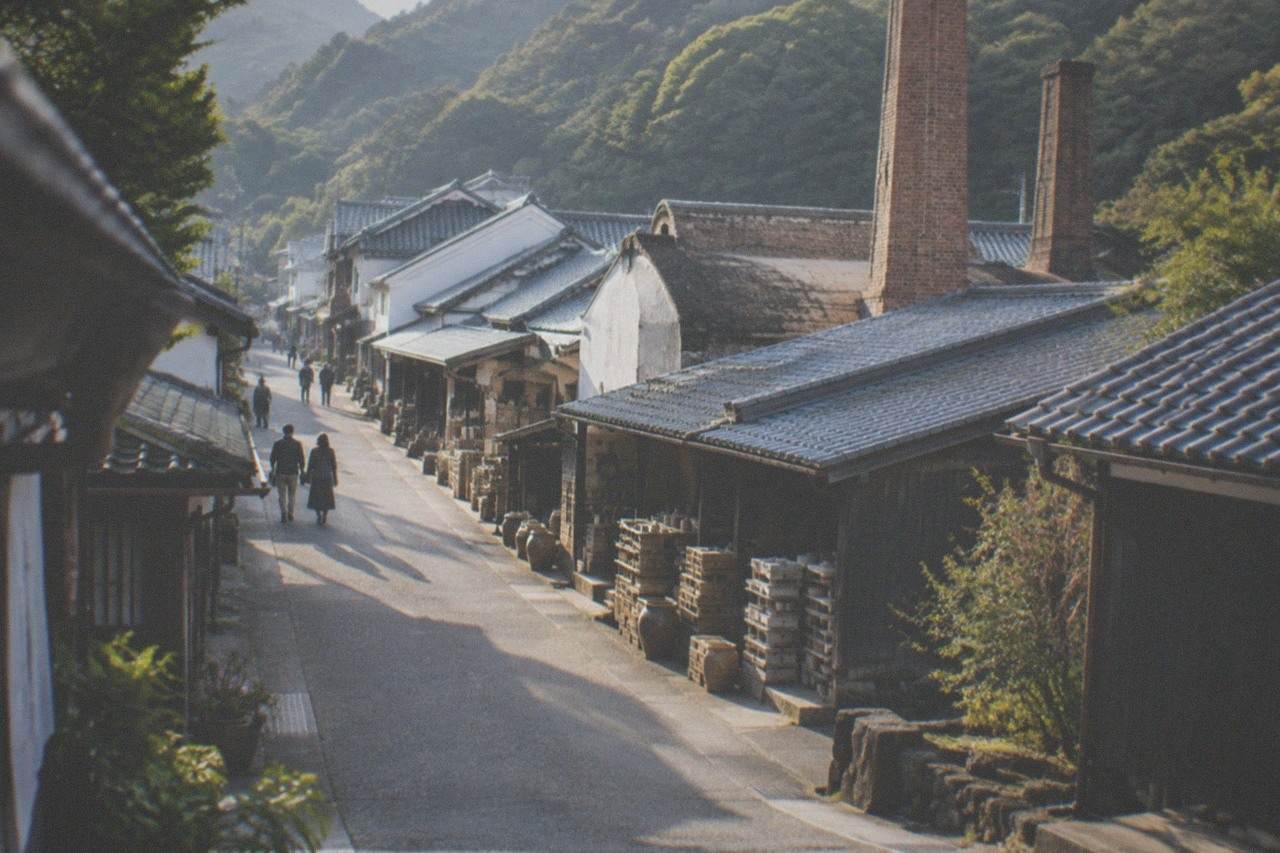
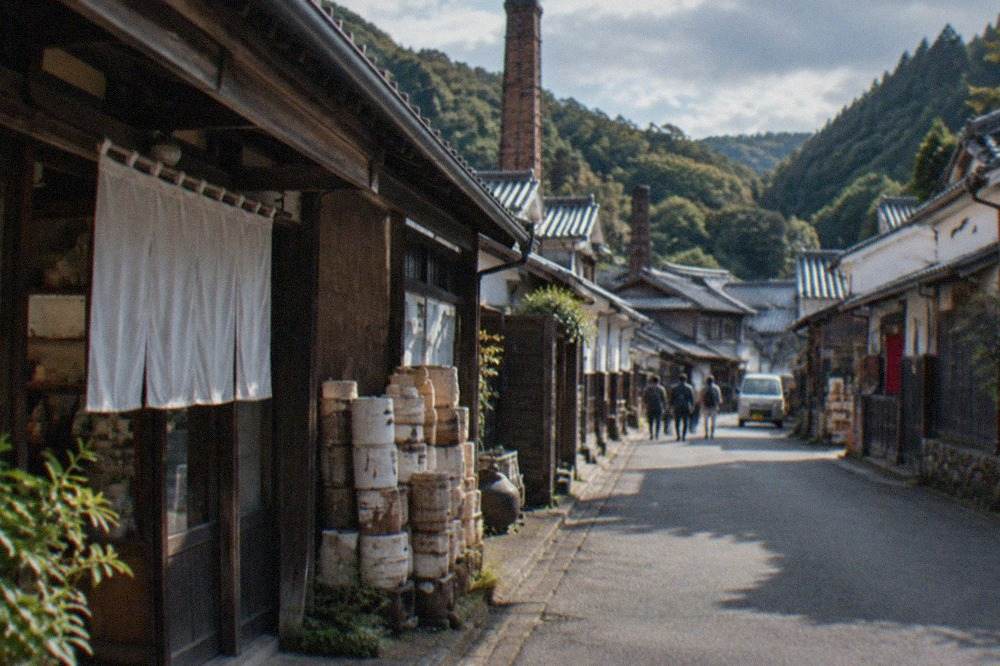
The industry shaped everything you now walk through. Arita's old town grew along the Yanagiyama kiln sites, and climbing kiln ruins, workshop buildings and shrine gates built from recycled kiln bricks and saggars still line its streets. Imari's historic district, the Okawachiyama village, sits in a mountain valley where the domain's official kilns operated under guard, producing ware reserved for the ruling family and for diplomatic gifts. Okawachiyama's stone walls, kiln remains and narrow lanes survive precisely because the village was deliberately kept remote.
What surprises many visitors is that both towns are still working centres rather than museums. Small studios produce tableware for Japanese restaurants, larger firms run factory outlets selling current and discontinued lines, and independent potters keep the decorative traditions alive. You are not looking at a preserved past. You are looking at a live industry that happens to be four centuries old, and one that pairs well with the bigger picture of what Fukuoka and Kyushu are known for.
How Do You Get from Fukuoka to Arita and Imari?
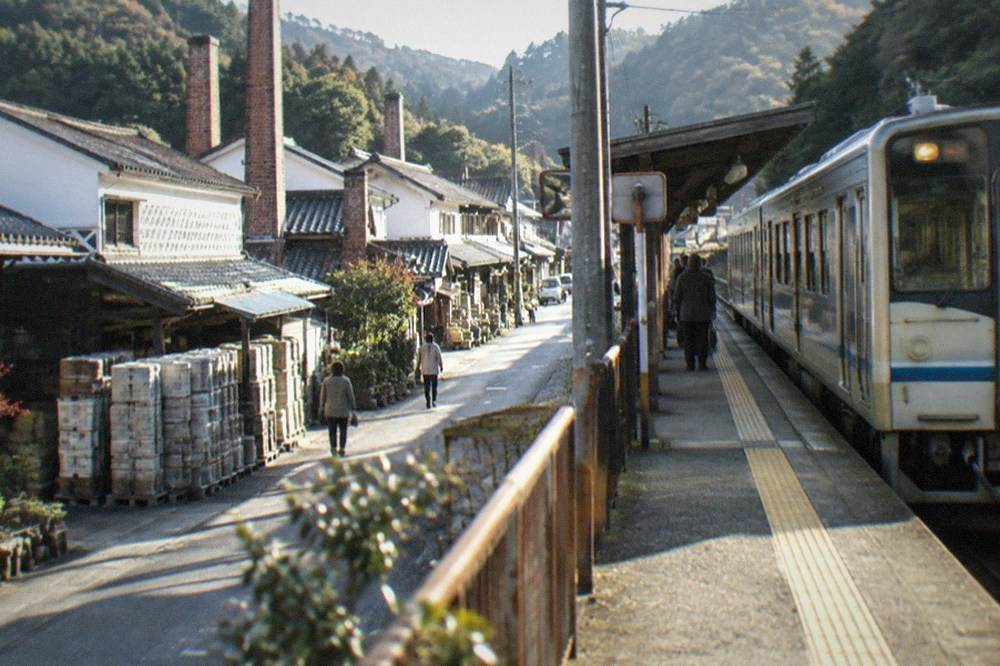
You reach both towns by JR train from Hakata Station, since Hakata is Fukuoka's main station and there is no separate JR Fukuoka station. Direct limited express services run from Hakata to Arita in roughly an hour and a half, and local trains continue from Arita to Imari in around half an hour more. A day trip works best with an early start, and the whole route sits within the area covered by the JR Kyushu Rail Pass if you hold one.
The practical detail that matters most: the Chikuhi and the limited express lines both serve this corridor, and Arita is the station for the porcelain town itself. From Arita Station, the main attractions cluster along the street that runs directly uphill from the station exit, so the town is effectively self-guiding. Imari Station is similarly central, with bus and taxi connections up to Okawachiyama village, which sits a short drive outside the town centre in its own valley.
If you are planning several rail days in northern Kyushu, the official JR Kyushu Rail Pass page explains the Northern Kyushu pass options, which cover this line and the rest of the region's JR network. Check the current pass prices on that page rather than relying on older guides, because fares and pass pricing have been revised in recent years. For a single day trip, individual tickets are usually the simpler choice, and you can buy them at Hakata's ticket counters or machines.
A sensible structure is Arita in the morning, Imari and Okawachiyama after lunch, and a limited express back to Hakata in the early evening. Some travellers reverse it, but Arita's shops and museums keep steadier daytime hours, and Okawachiyama is at its best in the softer afternoon light. If you would rather not manage the connections yourself, guided day tours out of Fukuoka are an alternative, and the selection below covers a range of styles and budgets.
The table below compares the two towns for planning purposes.
| Factor | Arita | Imari |
|---|---|---|
| Main draw | Kiln town, workshops, outlet shopping | Okawachiyama secret kiln village, historic port |
| Station to sights | Walkable from Arita Station | Bus or taxi from Imari Station to Okawachiyama |
| Best for | Buyers, ceramics fans, first-time visitors | Photographers, history, a quieter afternoon |
| Character | Working town with a museum district | Riverside town with a preserved mountain village |
| Time needed | Half a day | Half a day |
One Fukuoka habit worth breaking: do not plan this trip around the subway. The city subway, including the airport line, is for getting around Fukuoka itself, and its ¥260 airport fare is a different system from the JR lines you need here. Everything to Saga runs from Hakata's JR platforms.
What Should You See in Arita on a Day Trip?
Arita's core sights sit along one street running uphill from Arita Station: the porcelain museums, the historic Tonbai wall lanes built from kiln bricks, the Sueyama Shrine with its porcelain torii gate, and the workshop-and-outlet district. Most visitors spend the morning walking this axis, museum first, then the lanes, then shopping. The town is compact enough that you will not need a bus unless you venture out to the outer kiln sites.
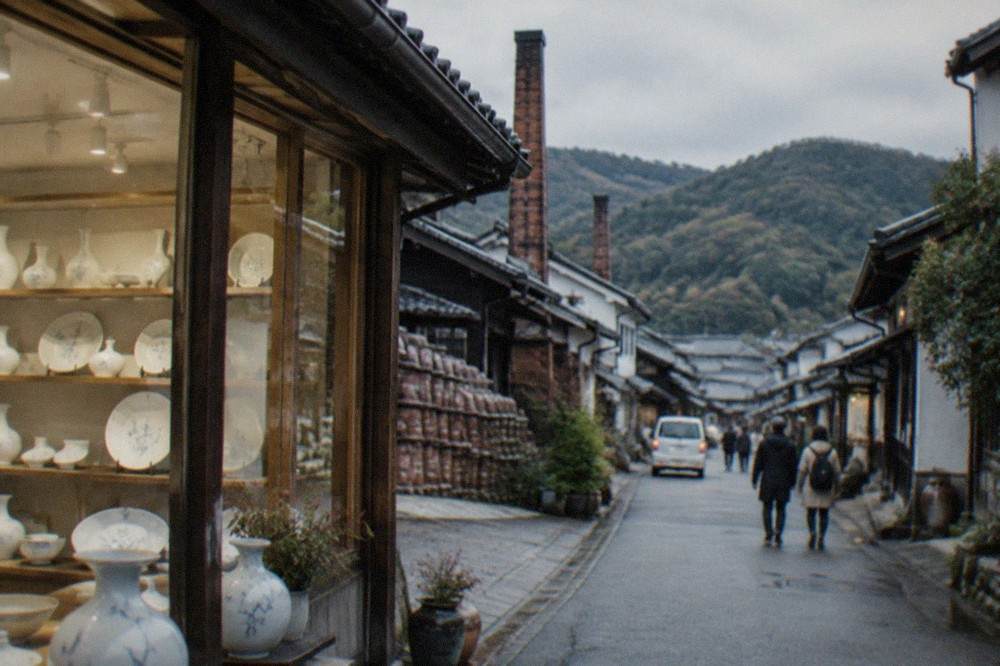
Start at the museum district near the station. The Kyushu Ceramic Museum is the heavyweight, holding a deep collection of local ware from the seventeenth century onward, including pieces donated from European collections that have come home. The Arita Porcelain Park, a short ride or a brisk walk further out, recreates a German palace facade in miniature and surrounds it with a porcelain museum and grounds; it is the most photographed spot in town and a favourite with families.
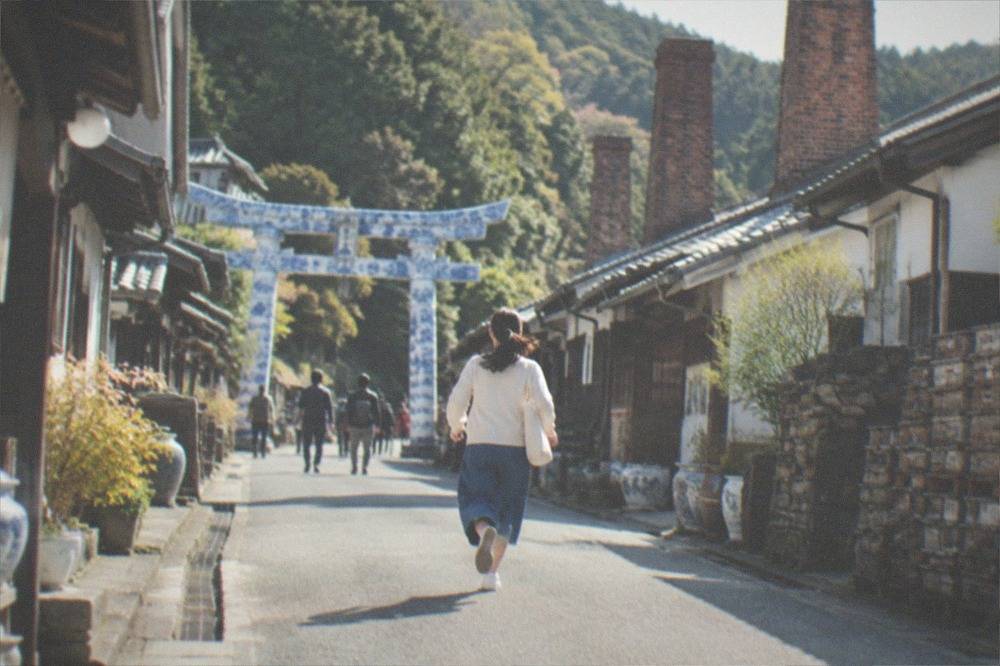
Between the museums, walk the back lanes. The Tonbai walls are the signature detail: fences and storehouses built from discarded firebricks and saggars, the fired clay boxes that protected porcelain in the kilns, stacked into patterns you will not see anywhere else. Sueyama Shrine, tucked partway up the hillside, has a torii gate and komainu guardian figures made of porcelain, which makes it the single most distinctive shrine visit in the region, and a nice contrast with the urban shrines of Fukuoka itself.
The Gen-emon and Fukagawa studios, among several long-established firms, run workshops you can view, and many sell factory seconds at the door. If you only have time for one interior space after the museum, choose a working studio over another retail floor: watching a decorator hand-paint a cobalt design explains more about Arita's value than any display case can.
Shopping deserves its own paragraph, and its own section later in this guide, but note that most outlets cluster on the main street and around the station, so you can leave purchases until you are heading back down the hill. Luggage-wise, travelling with a day pack rather than a suitcase makes the lanes and the trains easier, and Fukuoka's stations have luggage storage options if you are coming straight from a hotel checkout.
If a fully guided day appeals more than self-directing, a private guide changes the character of a day like this entirely, since a local escort can open doors in workshops that a walk-in visitor would pass by.
What Should You See in Imari on a Day Trip?
Imari's essential sight is Okawachiyama, the "secret kiln village" in a mountain valley a short bus or taxi ride from Imari Station, where the Nabeshima domain's official kilns produced top-grade porcelain under close control. The village keeps climbing-kiln remains, brick tunnels, narrow stone lanes and working studios, and it is the single best reason to include Imari rather than doubling your time in Arita. Allow two to three hours including the transfer.
Okawachiyama was the production site for Nabeshima ware, porcelain made exclusively for the ruling family and for gifts to shogunal and diplomatic circles. The domain restricted access so tightly that the village was effectively closed to outsiders for generations, which is why it survives as a near-intact Edo-period production settlement. You enter through a tunnel or over a pass, and the geography still tells the story: a walled valley, a stream for water power, kilns cut into the hillside.
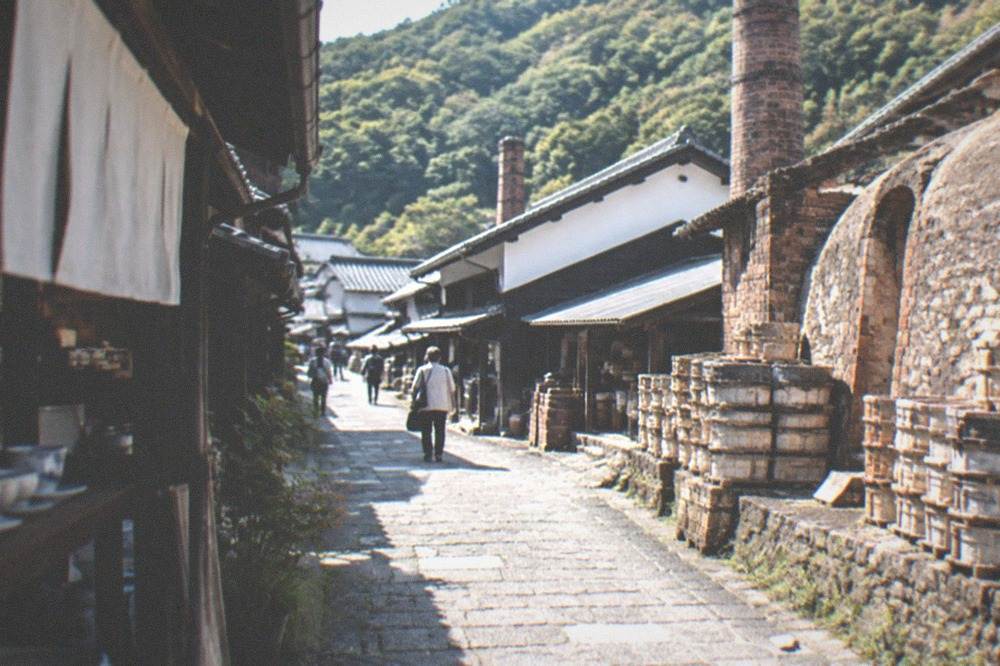
Inside the village, the walking route is obvious and short. The climbing kiln remains sit along the stream, several family studios sell directly from their doorsteps, and small museums display Nabeshima-style pieces. Porcelain elements are worked into the fabric of the place: bridges, lanterns, walls and gravestones all carry ceramic detail. It photographs beautifully in the late afternoon, which is one more argument for doing Arita first.
Back in Imari town proper, the riverfront and the old merchant district fill whatever time remains. Imari's history as the shipping port means warehouses and trade houses rather than kilns, and the town has a slower, lived-in feel than Arita's retail bustle. If you are stretching the day, the Imari ware museums in town round out the story of how the porcelain reached the outside world.
For travellers who enjoy pairing a day trip with a scenic train, note that some visitors route the return through Dazaifu for the shrine and its approach on a longer itinerary, but that is a two-destination day and better saved for a second outing. A cleaner pairing on a future trip is the industrial and retro streetscapes of Kitakyushu, which shares the same JR corridor north.
If you would like a guide to handle the valley's bus connections and timings, the touring option below covers the wider west-Kyushu coast and pairs well with this route.
That coastal tour runs a full day, so treat it as an alternative to this itinerary rather than an add-on to it. What it and the self-guided day share is the same starting point: Hakata's JR platforms, an early alarm, and a return to Fukuoka in time for dinner. Whichever way you go, the reassurance worth having is that the operator's live listing shows free cancellation, so a weather change or a typhoon-day rethink costs you nothing.
Where Should You Shop for Porcelain?
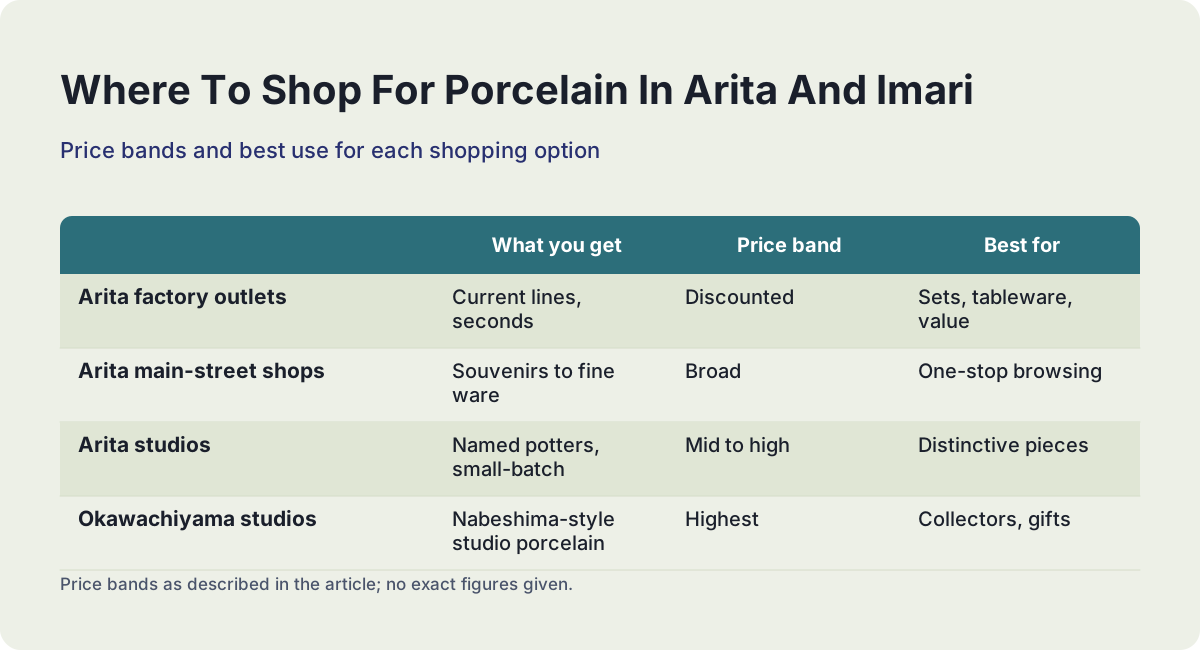
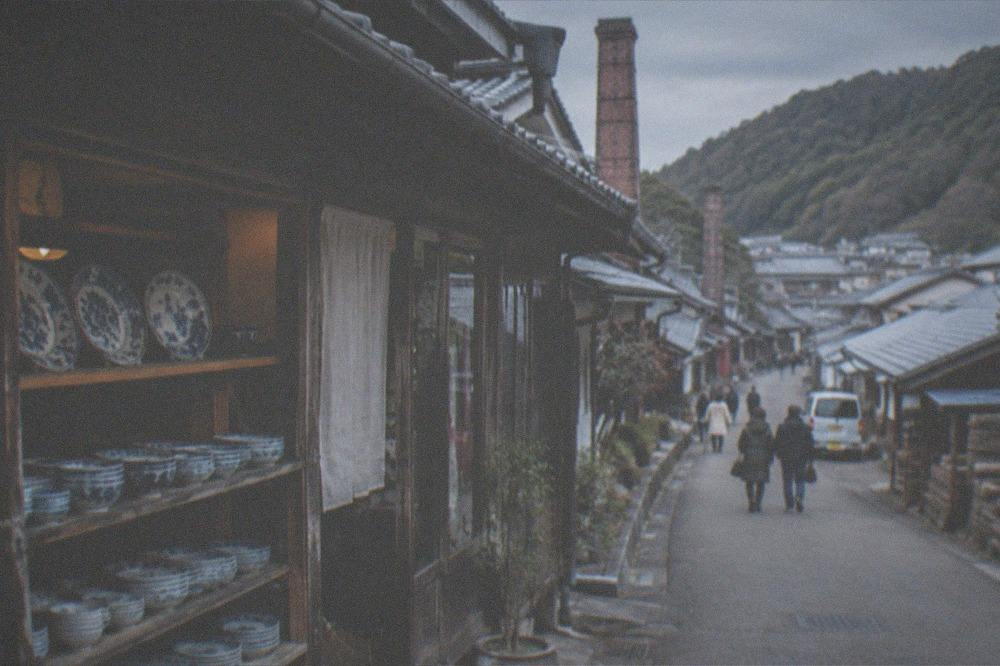
Shop in Arita for range and price, and in Okawachiyama for studio pieces you will not find elsewhere. Arita's factory outlets sell current lines and seconds at a discount, its main-street shops carry everything from tourist souvenirs to collector-grade ware, and the village studios in Imari sell direct from the makers at full artisan prices. Decide your budget before you shop, because the gap between a souvenir saucer and a hand-painted vase is enormous.
The honest hierarchy of Arita shopping looks like this. Factory outlets, run by the big established firms, are the value play: you buy real production ware, sometimes seconds with minor flaws, at marked reductions. Main-street retailers carry the widest selection across price bands, and staff in the larger shops are used to overseas shipping questions. Independent studios, in Arita and especially in Okawachiyama, are where you buy a named maker's work, and prices reflect the hours of hand decoration rather than kiln efficiency.
| Where | What you get | Price band | Best for |
|---|---|---|---|
| Arita factory outlets | Current lines, discontinued patterns, seconds | Discounted | Sets, tableware, value |
| Arita main-street shops | Full range from souvenirs to fine ware | Broad | One-stop browsing |
| Arita studios | Named potters, small-batch work | Mid to high | Distinctive pieces |
| Okawachiyama studios | Nabeshima-style studio porcelain | Highest | Collectors, gifts |
Two practical notes. First, check shipping before you fall in love with anything large: several of the bigger Arita firms ship internationally, but small studios often cannot, so plan luggage space accordingly. Second, wrapping is generally excellent in Japan, but a porcelain vase in a carry-on still needs your own padding for the flight home. Bubble wrap and a hard case are cheaper than heartbreak.
Ask shops whether what you are buying is hand-painted or transfer-printed if that matters to you; both are legitimate, and the price difference is real, but the honest shops will tell you straight. The same principle applies to "Imari" as a label: ware sold in Imari town is not necessarily made there, and ware made in Arita may carry the Imari name, because that is how the trade has worked for centuries.
When Is the Best Time to Visit Arita and Imari?
Spring and autumn are the best seasons for this trip: cherry blossoms and fresh greenery in late March and April, comfortable walking temperatures and autumn colour from late October through November. The porcelain events calendar peaks in spring, when Arita holds its major ceramics fair, and the summer months are hot and humid enough to make the valley walks of Okawachiyama hard work. Winter is quiet, cold and perfectly workable if you prefer museums without crowds.
The seasonal logic is the same as for the rest of northern Kyushu. Fukuoka's climate data show July as the wettest month of the year, ahead of June, with typhoon season running roughly from July through October, so midsummer carries both heat and storm risk for a day built around outdoor walking. The Japan Meteorological Agency's normals for Fukuoka put July rainfall at 299.1 mm against June's 249.6 mm, a detail most guides miss because they assume the rainy season itself must be the wettest stretch. Spring is the marquee window: the region's cherry blossoms open in late March and peak into early April, and Arita's spring ceramics period coincides with it, filling the town with visiting potters and temporary stalls.
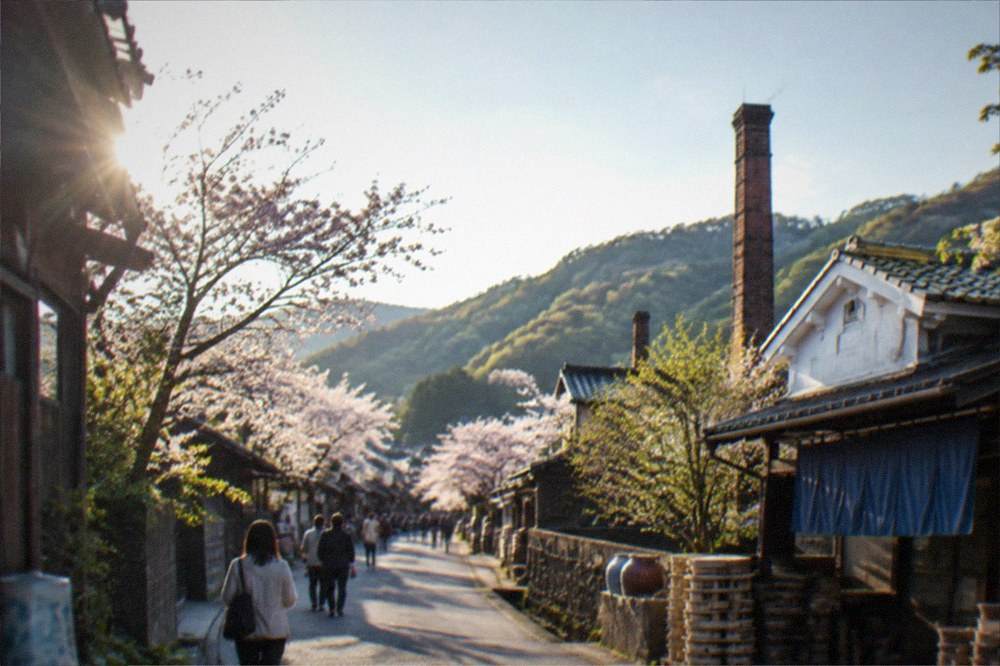
Autumn is the connoisseur's choice. Late November into early December brings colour to the hillsides around both towns, the weather is dry more often than not, and the studio shelves are full ahead of the year-end gifting season. The light in Okawachiyama's valley in November is a genuine photographic asset, and the same window is when Fukuoka's parks and gardens look their best, so the whole trip photographs well.
Weekends versus weekdays matters more here than in most day-trip destinations. Arita's spring fairs are weekend events and worth the crowds, but an ordinary weekend brings domestic tour groups to the outlets. A weekday visit gives you the lanes of Okawachiyama nearly to yourself, and the studios have more time to talk. If your Fukuoka itinerary allows a free weekday, spend it here.
| Season | Conditions | Notes for this trip |
|---|---|---|
| Late March to April | Mild, blossom season | Arita's spring ceramics events, busiest period |
| May to June | Warm, increasing rain | Comfortable walking, greener hills |
| July to August | Hot, humid, wettest months | Typhoon season begins; indoor shopping works |
| September to October | Warm, storm risk easing | Quieter, good value |
| November to early December | Cool, dry, autumn colour | Best light and colours in Okawachiyama |
| January to February | Cold, quiet | Museums and outlets without crowds |
Is a Day Trip to Arita and Imari Worth It from Fukuoka?
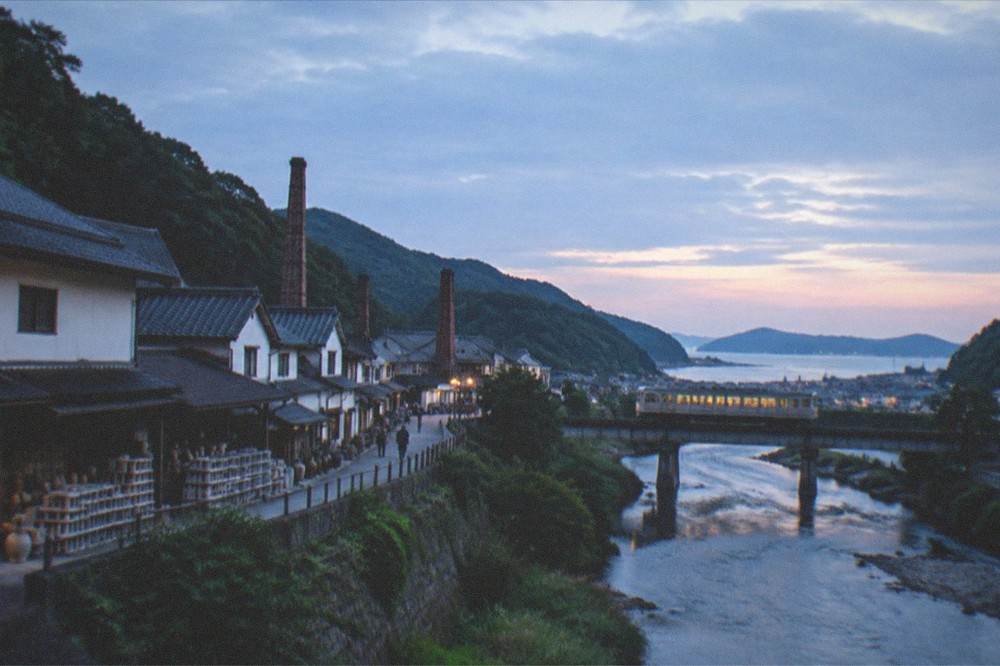
For anyone with an interest in ceramics, crafts, shopping or small-town Japan, yes, and unambiguously so: this is one of the most rewarding day trips out of Fukuoka precisely because it is nothing like the city. For a traveller with no interest in porcelain, it is still a pleasant ride through Saga's hill country, but the temple-and-shrine alternatives of Dazaifu or the coastal scenery of Itoshima will serve you better. The trip costs a full day, so match it to your interests honestly.
The comparison with Fukuoka's other day trips is worth making explicitly. Dazaifu is the culture-and-shrine half day, Itoshima is the coast and cafe day, and the full menu of day trips from Fukuoka covers everything from Yanagawa's canal boats to Beppu's hot spring hells. Arita and Imari stand apart as the craft-and-shopping option, and they suit a rainy day better than most, since the outlets and museums are indoors and the villages are atmospheric in drizzle rather than ruined by it.
Who should skip it? Travellers on a tight two-day Fukuoka stay should keep the city and Dazaifu. Visitors in late November who care mainly about autumn colour may find the mountain and gorge trips east of the city more photogenic. And anyone hoping for a buzzing, food-first destination should note that Arita and Imari are quiet working towns; dinner back in Fukuoka's yatai districts will do the eating.
For everyone else, the day delivers something the city cannot: four centuries of a single craft, visible in the streets themselves, in the hands of the decorators, and in the shops where it is all for sale. Pack a day pack, start early from Hakata, and go home with something wrapped in newspaper that will outlast every other souvenir of the trip.
If you would rather turn the day into a wider west-Kyushu circuit, the tour below is the comfortable way to do it, with the trains and timings handled for you.
Whatever you choose, this site's Fukuoka Japan Travel Guide keeps the planning side current, from transport fares to seasonal closures.
Common Questions About Arita and Imari Porcelain Day Trips
What Makes Arita And Imari Famous For Porcelain?
Arita is where Japanese porcelain was first produced, following the discovery of kaolin clay in the area in the seventeenth century, and Imari was the port through which the ware was shipped, which is why the porcelain became known abroad as Imari ware. Arita supplied both domestic elites and export markets, and its styles influenced European ceramics for generations.
How do I get from Fukuoka to Arita and Imari?
Take a JR train from Hakata Station, Fukuoka's main station. Limited express services reach Arita in roughly an hour and a half, and local trains continue on to Imari. The line is covered by the JR Kyushu Northern Kyushu Rail Pass if you hold one; check current pass prices on the official JR Kyushu page.
Can I do both Arita and Imari in one day?
Yes. Start early, spend the morning in Arita around the museum district and main street, then take the short local train to Imari and the bus or taxi up to Okawachiyama village for the afternoon. Finish with a limited express back to Hakata in the early evening.
Where is the best place to buy porcelain, Arita or Imari?
Arita for range and value, especially at the factory outlets selling current lines and seconds. Okawachiyama in Imari for studio pieces by named makers, at the top of the price scale. Check whether your purchase can be shipped internationally before buying anything large.
Is Arita a good day trip if I am not into ceramics?
It is pleasant but not compelling. The train ride through Saga's hill country is attractive and the towns are pleasant, but travellers without an interest in porcelain will usually get more from Dazaifu, Itoshima or the Kyushu coast trips. Arita suits craft lovers, shoppers and anyone curious about how a Japanese industry town works.