Nanzoin Reclining Buddha
Nanzoin, in the hills of Sasaguri east of Fukuoka city, holds one of the largest reclining bronze Buddha statues anywhere in the world, and most visitors to Fukuoka have never heard of it.
Short answer
Yes. The Reclining Buddha at Nanzoin temple in Sasaguri is a 41-metre bronze statue a short bus ride east of the city, there is no admission charge, and the site sits on a forested pilgrimage trail that most international visitors never reach. It is one of the most distinctive half-day trips you can make from Fukuoka.
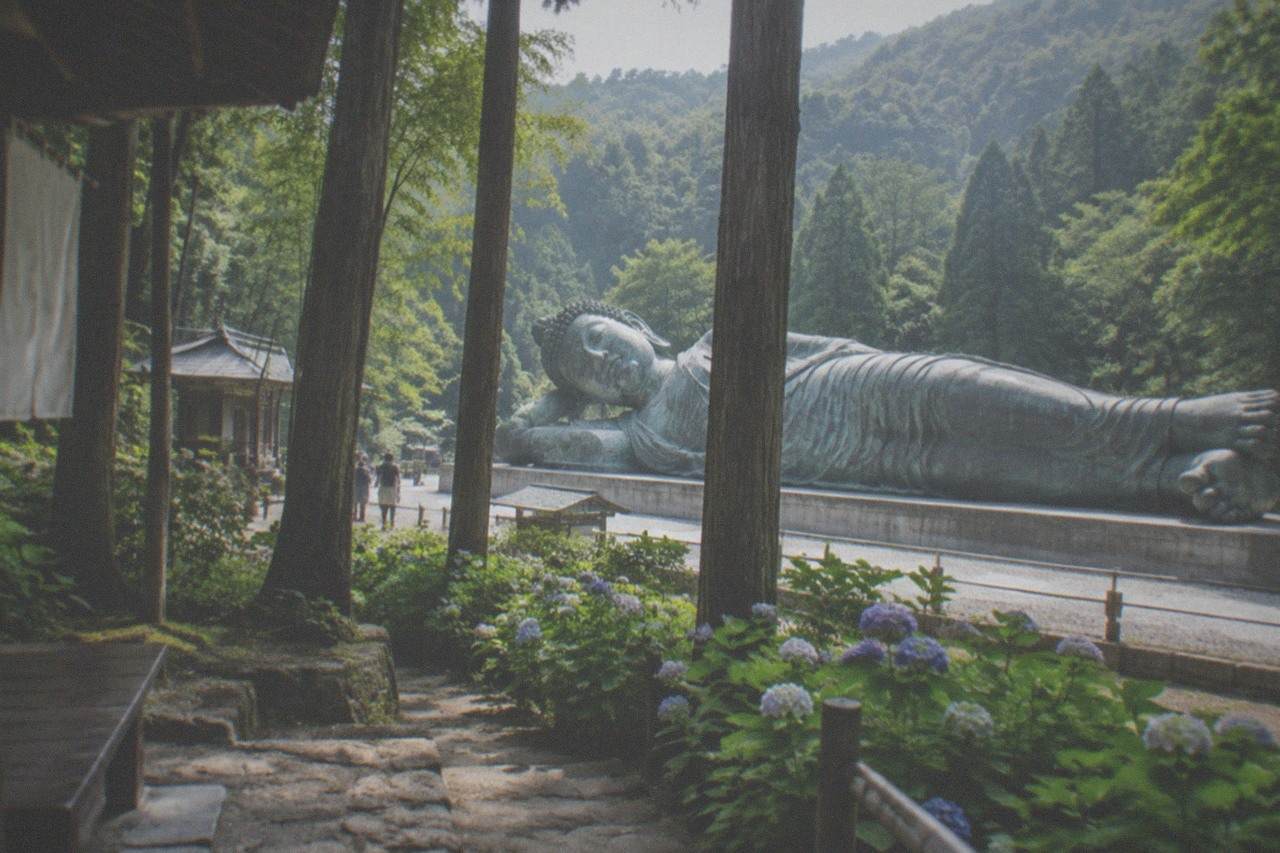
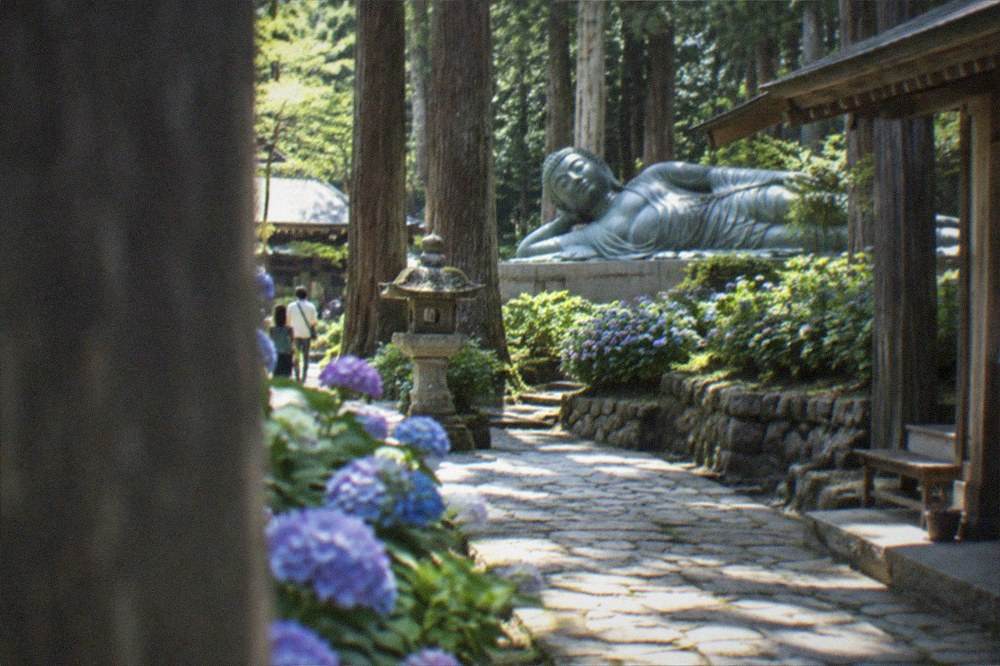
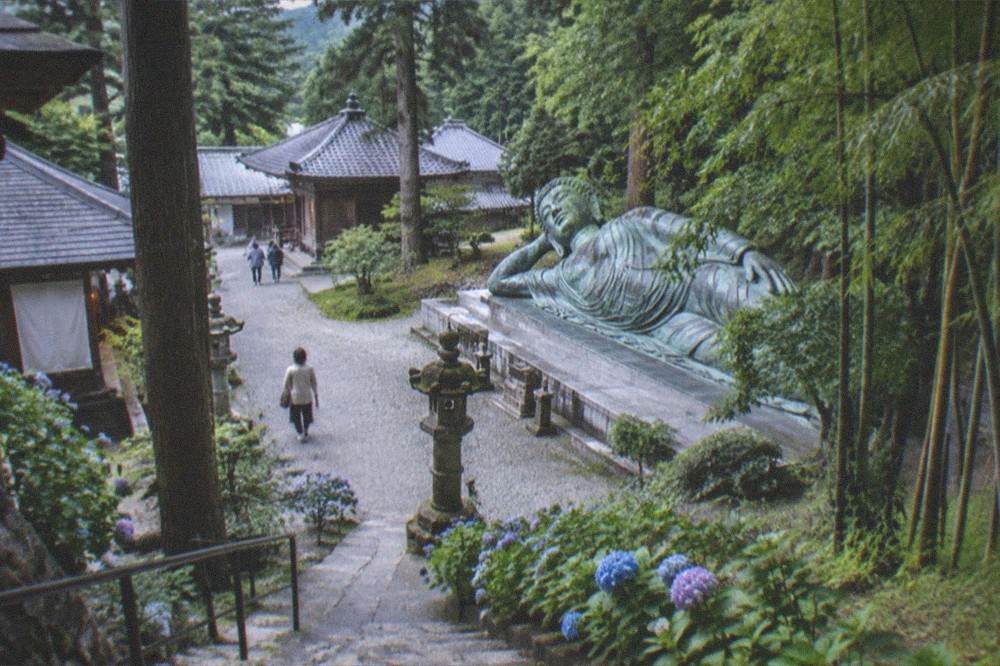
Fukuoka's most famous temples sit inside the city, within a subway ride of one another, and almost every visitor walks the same loop between Kushida Shrine and the temples of Hakata. Few make the short trip east. Nanzoin temple stands in the town of Sasaguri, in wooded hills on the eastern edge of Fukuoka Prefecture, and its great bronze Reclining Buddha lies down across an open plaza in a way no other major temple in Japan quite matches. At roughly 41 metres from head to toe, the statue, known as the Nehanzo, is one of the largest reclining bronze Buddhas in the world, and it draws Japanese pilgrims in steady numbers year round while staying almost completely off the international tourist map.
The temple's popularity at home is not hard to explain. Nanzoin is the head temple of the Sasaguri pilgrimage, a walking route of Buddhist temples threaded through the hills around the town, and the Reclining Buddha itself carries a reputation as a power spot. Visitors come to rub the statue's body at the point where they carry their own pain, a practice the temple openly encourages, and they come for goshuin, the calligraphic temple stamps collected in a book. What you get is a half day of forest, incense and a very large sleeping Buddha, about as far in mood from Fukuoka's neon districts as the prefecture allows.
This guide covers whether the trip is worth your time, how to get there, what you can actually do at the temple, and how it compares with other big Buddha statues in Japan.
Is Nanzoin Reclining Buddha Worth Visiting?
Yes, for most travellers Nanzoin is worth the half day, as long as you know what it is. This is a working pilgrimage temple, not a museum piece behind glass: the main draw is a 41-metre bronze reclining Buddha you can walk right up to and touch. Admission is free, the forested grounds are extensive, and the journey out is short, making it one of the best half-day trips from Hakata or Tenjin if your interest extends past the city centre.
The honest caveat is that this is a Japanese-language destination. Signage in English is limited, the temple's information is pitched at domestic pilgrims, and you will not find the multilingual handouts and tour infrastructure that Kushida Shrine in the city centre takes for granted. Some visitors find that refreshing. Others, particularly those with limited time in Fukuoka, will get more from an afternoon at Tochoji's seated Great Buddha in Hakata or the temples around Shofukuji Temple, all reachable on foot.
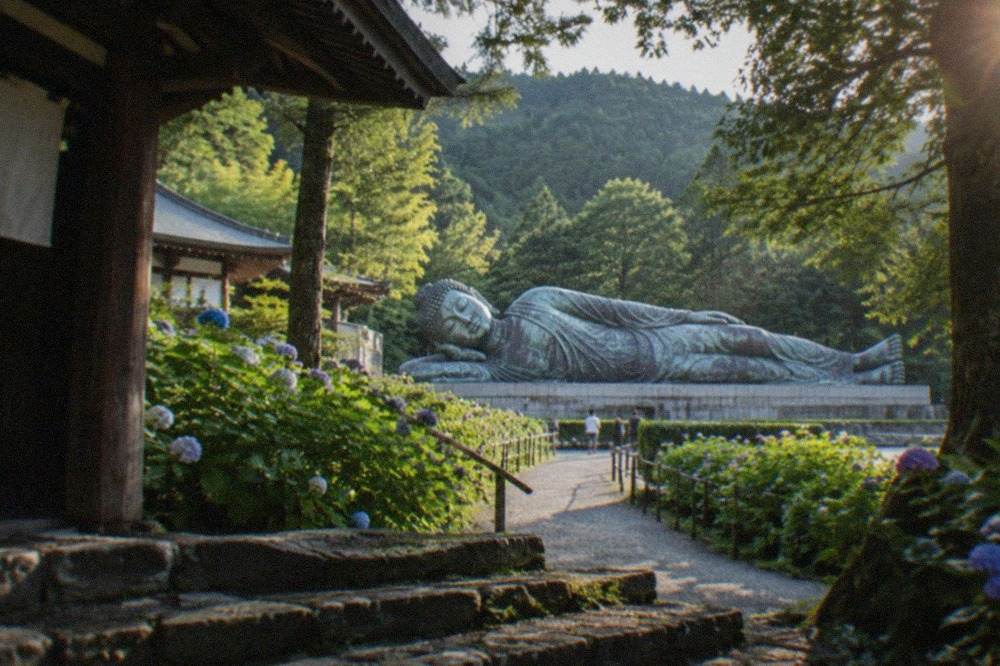
The strongest argument for going is the statue itself. Japan has grand seated Buddhas in Nara and Kamakura, but a reclining Buddha of this size, in bronze, in an open hillside plaza, is genuinely rare in the country. The sight of the statue's head, chest and feet rising out of the courtyard in a single line, with forest behind it, is an image you will not get anywhere else in Kyushu. Pilgrims queue to press their hands against it. Photographers come for the scale. Even travellers with no particular interest in Buddhism tend to walk away impressed by the sheer physical presence of the thing.
What Is the Reclining Buddha and Why Do People Rub It?
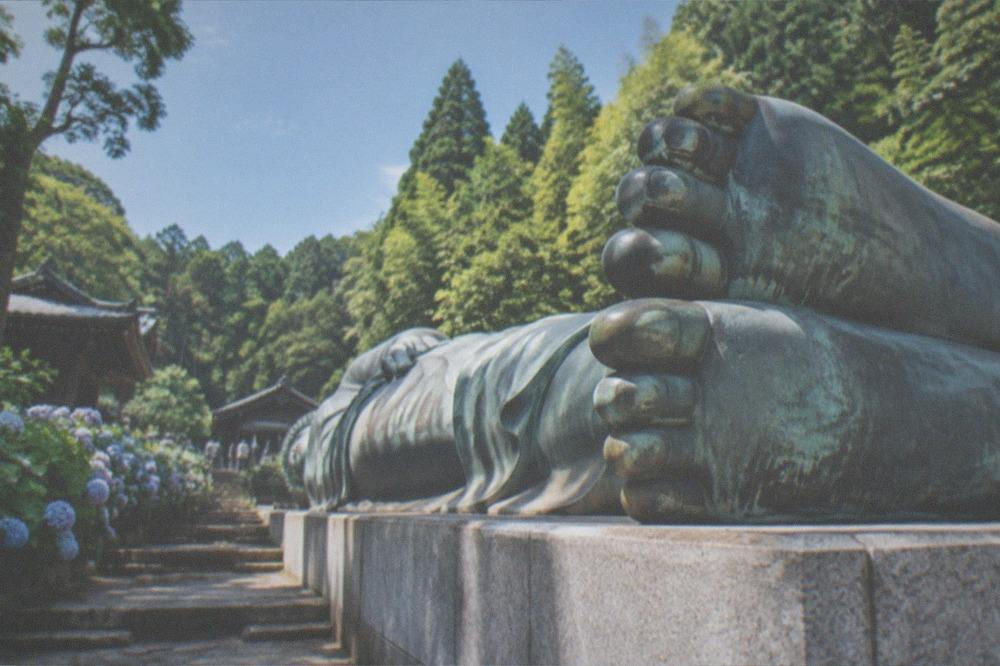
The Nehanzo depicts Buddha at the moment of entering nirvana, lying on his right side with his head pillowed on his right hand, and at Nanzoin the statue is cast in bronze at roughly 41 metres long. Visitors are invited to touch the statue, and the popular practice is to rub the part of the Buddha that corresponds to the part of your own body that hurts. The grounds are open to everyone, and there is no admission charge.
The reclining posture is one of the standard poses of Buddhist iconography, the nehan posture, and it represents the final moments of the historical Buddha's life, a state of complete release. Nanzoin's statue is exceptional not for the theology but for the execution: it is a very large bronze poured in the modern era, replacing an earlier wooden statue that was destroyed, and its unveiling followed years of casting work. The temple publishes little in English about the construction, but the scale speaks clearly enough when you stand at the feet.
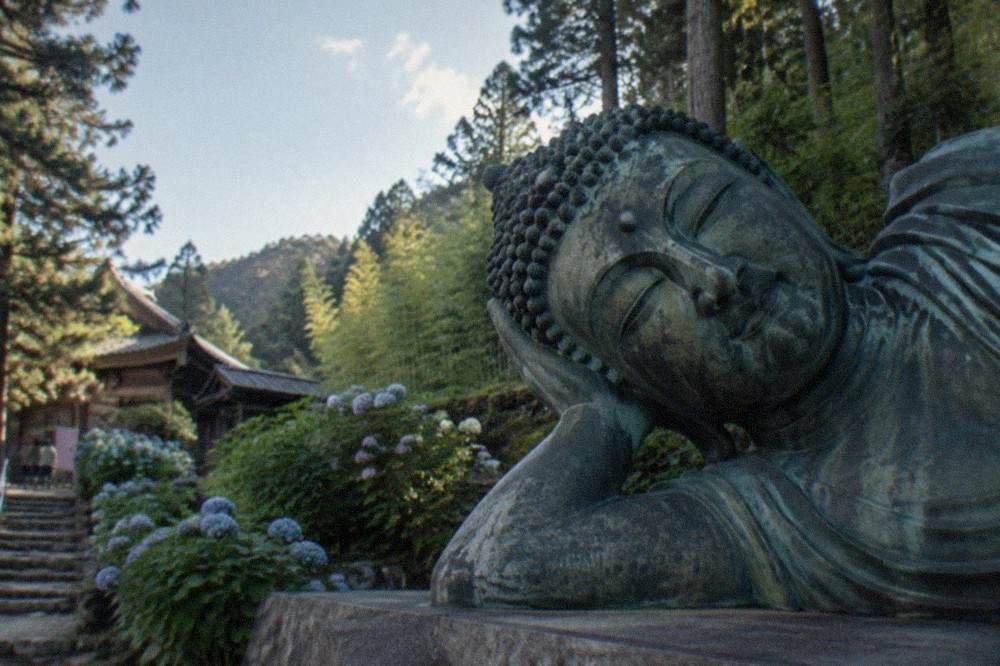
The rubbing custom is what gives Nanzoin its reputation as a healing power spot. The idea is simple and the temple endorses it: if your shoulder hurts, rub the Buddha's shoulder. If it is your knee, rub the knee. Pilgrims file along the statue's flank with a hand raised, and the bronze at head height has been polished by decades of contact. Nothing about the practice is secret or restricted, and you will see visitors of every age taking part. It is one of the few major religious monuments in Japan where touching the object itself is not merely tolerated but is the entire point of the visit.
| Item | Details |
|---|---|
| Statue name | Nehanzo, the Great Reclining Buddha |
| Posture | Lying on the right side, head on the right hand |
| Length | Approximately 41 metres |
| Material | Bronze |
| Access to the statue | Open plaza, visitors may touch and rub the statue |
| Admission | No admission charge |
| Location | Nanzoin temple, Sasaguri, east of Fukuoka city |
Around the plaza, the temple grounds continue into the hillside. There is a main hall for worship, incense burners, statuary along the paths, and the starting section of the Sasaguri pilgrimage trail, the route of numbered temples that winds up through the woods. The pilgrimage is a local version of the famous 88-temple walk of Shikoku, compressed into a range of hills that can be walked in a day or two, and Nanzoin serves as its administrative head. Even if you walk none of it, the trailhead paths behind the temple give a sense of what the route is.
How Do You Get to Nanzoin from Fukuoka?
Nanzoin sits in the town of Sasaguri, on the eastern side of Fukuoka Prefecture, roughly a short local bus ride from JR Yoshizuka Station on the eastern edge of Fukuoka city. Buses run from the station up to the temple, and the full trip from Hakata or Tenjin involves a suburban train followed by the bus. There is no subway line to Sasaguri, so you need a train, a bus, or a car, and there is no reason to take a taxi for the whole distance.
The usual route from the city centre is the JR line from Hakata toward Yoshizuka and on east. Yoshizuka Station is the practical boarding point for the temple bus, a few stops out from Hakata, and the Nishitetsu bus routes from that station serve the temple stop directly. If you are starting from Tenjin, the Nishitetsu bus network also runs services east toward Sasaguri from the city's main bus terminals. Timetables are published by the operators and vary between weekdays and weekends, so check the day's schedule before you set out rather than trusting a fixed pattern.
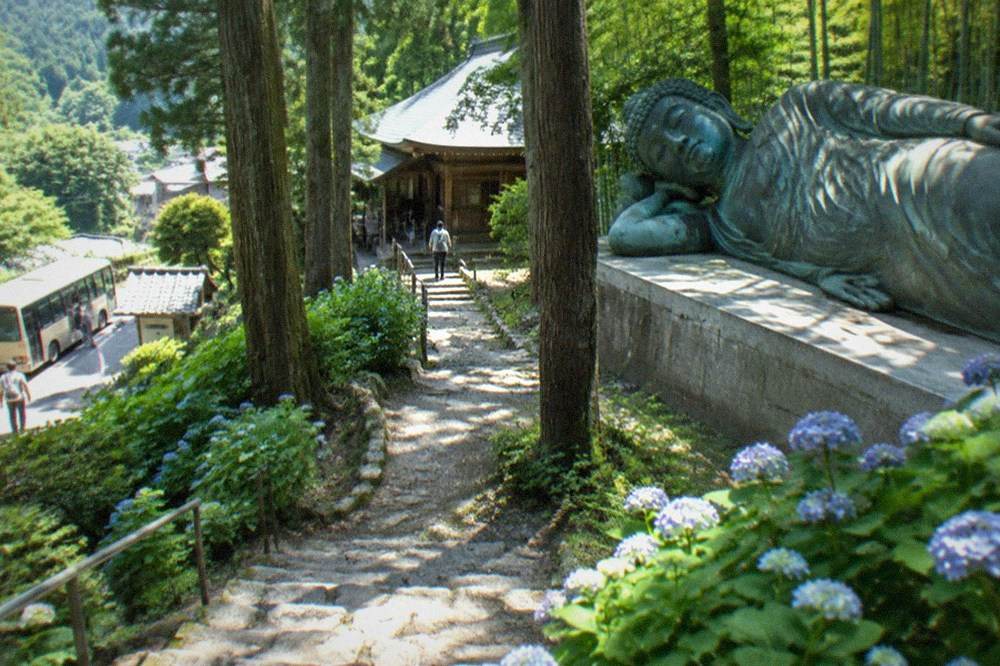
For travellers without Japanese, the journey is easier than it sounds. The train out of Hakata is a standard JR local or rapid service, Yoshizuka is announced in the usual way, and the temple bus is a well-used pilgrim route that the bus stop names in kanji. Have your destination written or saved on your phone. IC cards such as nimoca, SUGOCA and their national equivalents are accepted across these networks, so you do not need to fuss over individual paper tickets for the suburban legs.
| Leg | How | Notes |
|---|---|---|
| Hakata or Tenjin to Yoshizuka | JR local train from Hakata | Short suburban ride east; IC cards accepted |
| Yoshizuka Station to Nanzoin | Nishitetsu local bus | Stops at the temple entrance; check the day's timetable |
| Direct from Tenjin | Nishitetsu bus services toward Sasaguri | Runs from the main bus terminals; verify the route number on the day |
| By car or taxi | Local roads east from the city | Parking is available near the temple entrance; a taxi for the full distance is poor value |
One planning note worth stating plainly: this is a half-day trip, not a full day, unless you intend to walk part of the pilgrimage trail. If you pair Nanzoin with a morning in Hakata's temple quarter, Tochoji Temple with its Great Buddha and Jotenji with its Zen garden are both right next to the station you will leave from, which makes a natural combined route.
What Else Can You See at Nanzoin Temple?
Beyond the Reclining Buddha, the temple grounds include a main worship hall, a goshuin stamp office, small halls and statuary along the paths, and the starting section of the Sasaguri pilgrimage trail into the hills. There are shops near the entrance selling pilgrimage goods, incense and refreshments, and the temple issues its own calligraphic stamps for collectors. Plan on one to two hours for the grounds themselves if you are not walking the trail.
The goshuin tradition is worth a paragraph for anyone who has not collected one before. A goshuin is a hand-brushed inscription of the temple's name and date, pressed with red seals onto a dedicated book you buy at the temple. Nearly every temple in Japan issues them, and Nanzoin's, given its status as the head of a pilgrimage route, is a meaningful one for collectors. The stamp office is also the place to pick up pilgrimage clothing, staffs and the written slips walkers carry on the Sasaguri route, all of which make sense if you plan to walk even a couple of the numbered temples. The full index of guides sits on Fukuoka Japan Travel Guide.
If the brushwork on those temple stamps appeals to you, a calligraphy session back in the city is a natural companion to the day. The Fukuoka Japanese Calligraphy Experience is a small-group class where you handle the same brush-and-ink materials a temple calligrapher uses, and it needs no prior skill or Japanese. It runs about two hours, and like every experience in this article it can be reserved on the operator's live listing with free cancellation if your plans shift.
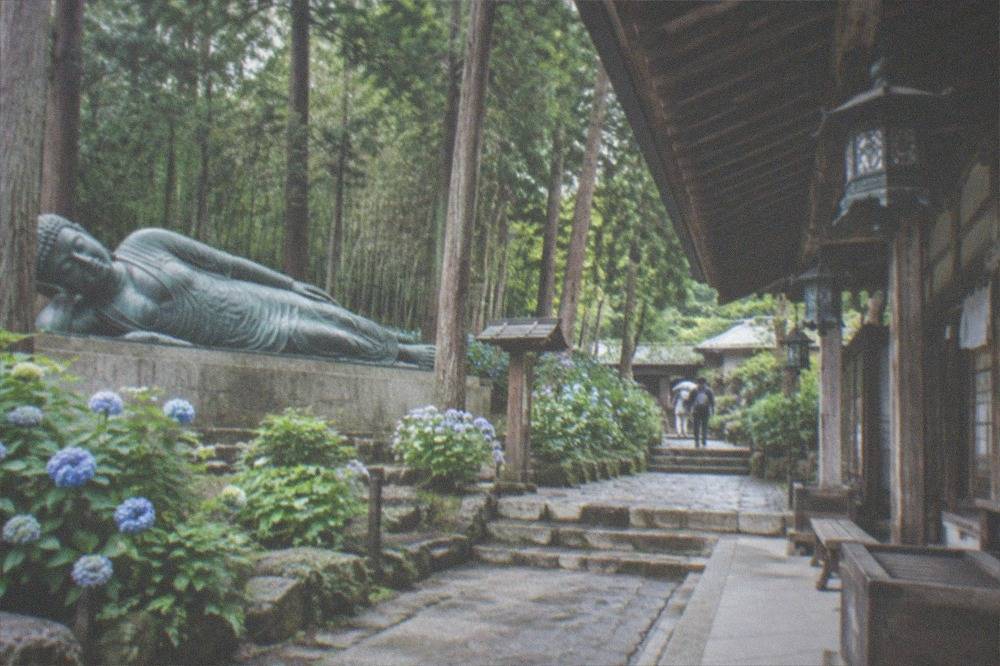
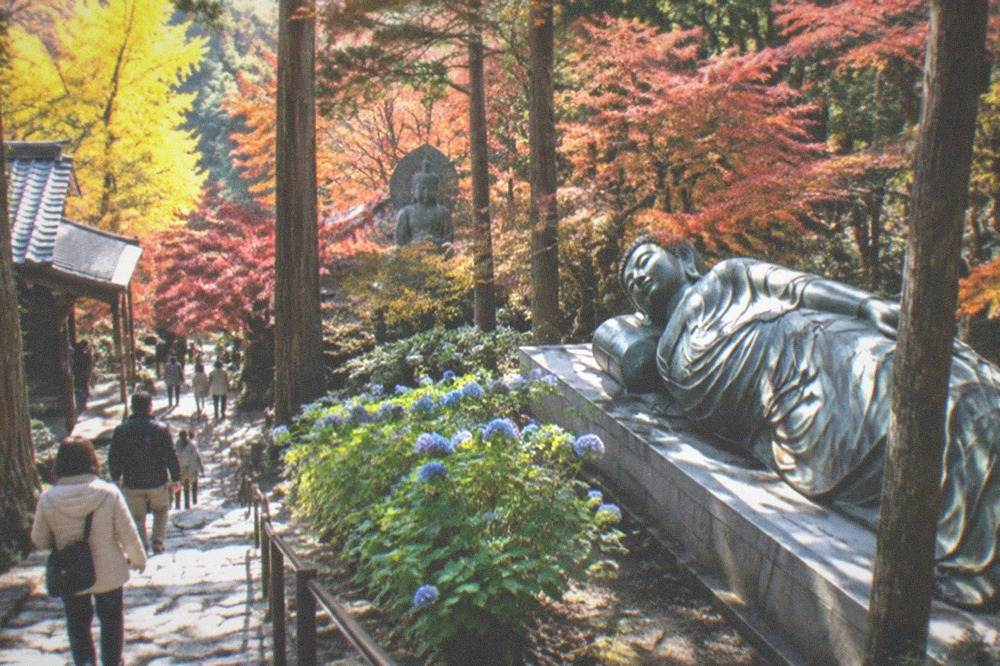
Around the grounds, look for the small details that make temple visits in Japan rewarding. The incense burner in front of the main hall, where pilgrims waft smoke toward whatever ails them, follows the same healing logic as the statue rubbing. Stone guardians line the steps. The trees do much of the work at Nanzoin: the temple sits in a valley of cedars and pines, and the walk from the bus stop up to the plaza is itself part of the atmosphere. In autumn the hills around Sasaguri turn, and the temple's maple and ginkgo make late November a strong season to combine with the city's own late colour, which holds into early December.
| What to do | Where | Allow |
|---|---|---|
| See and rub the Reclining Buddha | Main plaza, straight ahead from the entrance | 20 to 30 minutes |
| Collect a goshuin stamp | Stamp office in the temple complex | 10 minutes plus queue |
| Main hall worship and incense | Main hall above the plaza | 10 minutes |
| Walk a section of the pilgrimage trail | Trailheads behind the temple | 30 minutes to half a day |
| Refreshments and pilgrimage goods | Shops near the entrance | 15 minutes |
When Is the Best Time to Visit Nanzoin?
Spring and autumn are the best seasons: late March to early April for cherry blossom in the Sasaguri valley, and mid to late November for autumn colour on the surrounding hills. Summer visits are possible but hot and wet, with July the wettest month of the year in Fukuoka at 299.1 mm of rain against June's 249.6 mm, and winter is quiet, dry and cold in the mornings. The temple itself does not close for winter.
The climate numbers behind that advice come from the Japan Meteorological Agency's normals for Fukuoka station, and they are worth reading closely because they contradict what most guides assume. Everyone assumes June, the tsuyu rainy season month, is Fukuoka's wettest. It is not. July is, at 299.1 mm against June's 249.6 mm, and July is also the month of the Hakata Gion Yamakasa festival, when hundreds of thousands of people stand in the open air in the small hours. For a hillside temple visit, that matters: a July afternoon trip to Sasaguri carries a real chance of a soaking.
| Month | Mean temp | Rain mm | Sunshine hours | Verdict for Nanzoin |
|---|---|---|---|---|
| March | 10.8 °C | 103.7 | 161.2 | Late-month blossom starts |
| April | 15.4 °C | 118.2 | 188.1 | Best overall month |
| May | 19.9 °C | 133.7 | 204.1 | Brightest month of the year |
| July | 27.4 °C | 299.1 | 172.2 | Wettest month; hot and humid |
| August | 28.4 °C | 210.0 | 200.9 | Hot, sunny, typhoon season |
| November | 14.2 °C | 91.4 | 137.3 | Autumn colour; dry and mild |
| December | 9.1 °C | 67.5 | 112.2 | Quiet, cold, clear skies |
Typhoon season runs roughly July through October across western Japan, and the JMA's live typhoon feed is the honest way to check it before a temple day, because a hillside temple with an open plaza is exactly the kind of place a typhoon day closes or empties. Neither the rainy season nor typhoon season makes Fukuoka unvisitable, but for Nanzoin specifically, a dry November or a bright May gives you the best version of the place: clear views down the statue's flank, dry stone paths and the pilgrimage trail walkable.
Nanzoin vs Other Big Buddha Statues in Japan
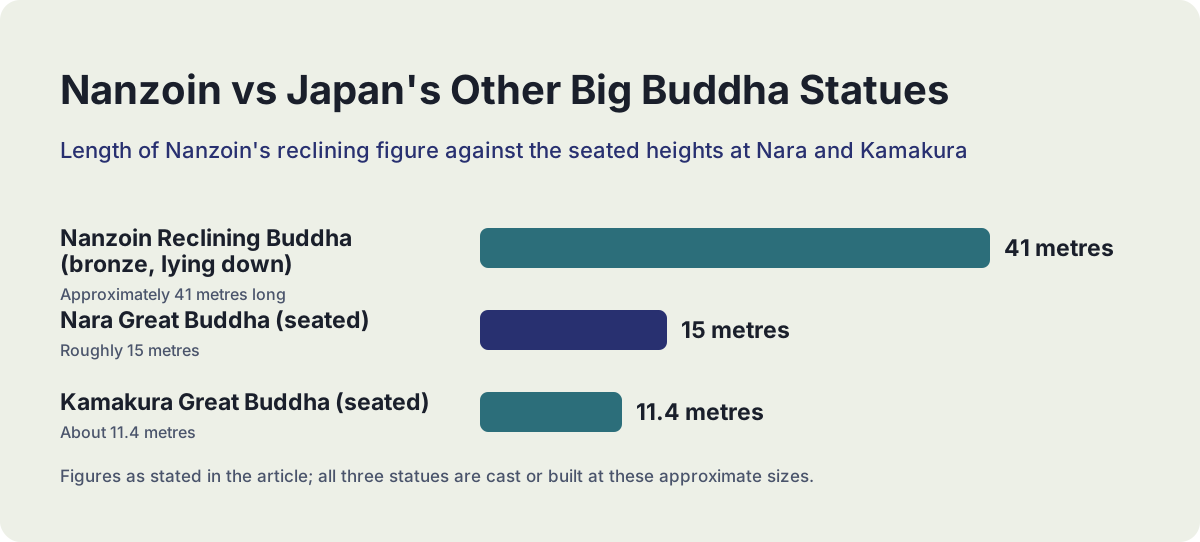
Japan's other great Buddhas are seated or standing, which makes Nanzoin's reclining figure a category of one: the Nara Great Buddha sits at roughly 15 metres and Kamakura's sits at about 11.4 metres, while Nanzoin's bronze lies down at around 41 metres, longer than those statues are tall. If you have seen Nara or Kamakura and found them moving, Nanzoin is the natural next piece of the set, and it is the only one you can touch.
The comparison is worth making honestly in both directions. Nara's Daibutsu is a national monument of the eighth century, with a hall, a history and a museum apparatus around it; Kamakura's is one of the most photographed objects in the country. Nanzoin is neither ancient nor famous abroad, and its statue dates from the modern era. What it offers instead is intimacy and setting: no queue timed by the half hour, no crowds pushed past on a fixed route, and a bronze surface polished by human hands rather than fenced off behind railings.
For visitors who want the monument experience without the train ride east, Fukuoka city keeps its own modern religious and artistic spectacles closer to hand. Tochoji Temple in Hakata holds a large seated Great Buddha inside a hall, and the teamLab Forest Fukuoka immersive art experience, with its digital forest and athletics-themed light spaces, is reachable on the city's east side, a few subway stops from Hakata. A rainy-day pairing of Tochoji in the morning and teamLab in the afternoon covers the indoor bases while Nanzoin's hills wait for better weather.
A Half-Day Plan: Nanzoin with the City's Temple Quarter
The most efficient plan pairs the city centre temples in the morning with Nanzoin after lunch: start at Hakata's Kushida Shrine and Jotenji, walk to Tochoji's Great Buddha, then take the JR train east from Hakata to Yoshizuka and the bus up to the temple, returning to the city in time for dinner. This gives you two very different faces of Japanese Buddhism, the urban and the forested, inside one day without a car.
Morning in Hakata needs no ticketing and no reservations, which makes it the flexible half of the day. Kushida Shrine, Hakata's principal shrine, sits a few minutes from the station, with Shofukuji Temple, Japan's first Zen temple founded in the city, and Jotenji with its raked gardens within the same walkable quarter. Tochoji's Great Buddha hall closes in the late afternoon, so see it before you head east rather than after.
If you would rather not self-drive the temple quarter, the Fukuoka Private and Personalized Walking Tour with a Local covers the Hakata temple and shrine quarter in about two hours with a local guide who sets the route with you, which pairs neatly with an independent afternoon at Nanzoin. It runs from about $64 per person, rated 4.7 from 46 reviews, and the operator's live listing shows the current departure times. A guided morning in the city plus an unguided afternoon in the hills is a comfortable division of labour for a first visit.
| Time | Plan |
|---|---|
| Morning | Kushida Shrine, Jotenji, Shofukuji and Tochoji on foot in Hakata |
| Lunch | Hakata Station area, near the boarding point for the eastern trains |
| Early afternoon | JR train east to Yoshizuka, bus to Nanzoin |
| Afternoon | Reclining Buddha, main hall, goshuin stamp, start of the pilgrimage trail |
| Evening | Bus and train back to the city; Nakasu or the station quarter for dinner |
The order can be flipped in high summer, when the hills are better in the cooler morning and the city temples are shaded and indoor-cool in the afternoon. Either way, keep Nanzoin's bus timetable in mind when you leave: the last buses back down to Yoshizuka run earlier than a city visitor expects, and the walk down the temple road is long and unlit after dark.
Visitor Etiquette and Practical Tips
Nanzoin is an active religious site, not a photo park: dress modestly, keep your voice low around the main hall, follow the local practice at the statue rather than inventing your own, and take cash, because the temple's shops and stamp office are not reliably card-friendly. Photography of the statue and grounds is generally accepted, but not of worshippers or where halls prohibit it. The temple sits in a wooded valley with steps and slopes, so ordinary shoes serve better than fashion ones.
The etiquette at the statue itself is simpler than at most monuments. Pilgrims rub the bronze at the point matching their own ailment, and there is no prescribed ritual beyond that; watch what the people ahead of you do and you will have the pattern. At the main hall, the customs are the standard Japanese temple ones: a small coin in the offering box, a bow, incense in the burner if you wish. No one will police a visitor who simply stands respectfully at the back.
| Do | Why |
|---|---|
| Carry cash | Temple shops and the stamp office are not reliably cashless |
| Rub the statue gently | The custom is touch, not percussive massage |
| Ask before photographing people | Pilgrims at worship did not come to be a backdrop |
| Keep to the marked paths | The grounds back onto private forest and trail sections |
| Check the bus timetable before arriving | The return buses thin out in late afternoon |
A few closing practicalities. There is no luggage storage at the temple, so travel light or leave bags in the city, where Hakata Station and the airport offer coin lockers. The paths are stepped and sloped in places, which is fine for most visitors but worth knowing for anyone with limited mobility; the plaza itself is reachable with assistance. And the temple's daily rhythm is an ordinary temple's, busiest on weekends and quiet on weekday mornings, which is the version of it regulars recommend.
Common Questions About Nanzoin Reclining Buddha
Is Nanzoin Reclining Buddha Worth Visiting?
For most travellers, yes. It is a 41-metre bronze reclining Buddha in a forested temple valley a short train and bus ride from Fukuoka city, with no admission charge and a touch-and-rub custom you will find almost nowhere else at this scale. If you have half a day and any interest in Buddhism, temples or simply unusual sights, it is one of Fukuoka's best excursions.
How long is the Reclining Buddha at Nanzoin?
Approximately 41 metres from head to toe, cast in bronze, depicting Buddha in the nehan posture of entering nirvana. It is one of the largest reclining bronze Buddhas in the world and is significantly longer than Japan's famous seated Great Buddhas in Nara and Kamakura are tall.
Is there an admission fee at Nanzoin temple?
No admission charge is made for the temple grounds or the plaza where the Reclining Buddha lies. Visitors typically spend money only on temple stamps, incense, offerings and goods from the shops near the entrance, all optional.
Why do visitors rub the Reclining Buddha?
The temple encourages the practice as a healing custom: you rub the part of the statue corresponding to the part of your own body that hurts, a shoulder for a shoulder, a knee for a knee. The bronze at reachable height has been polished smooth by decades of pilgrims doing exactly that, and visitors of every age take part.
How do you get to Nanzoin from Fukuoka city?
Take a JR train east from Hakata to Yoshizuka Station, then the local Nishitetsu bus up to the temple stop in Sasaguri. Nishitetsu bus routes from the city's main terminals also serve the area. There is no subway line to Sasaguri; the trip is a train, a bus, or a car.
Can you combine Nanzoin with other Fukuoka sights in one day?
Yes, and it works well. A half-day plan pairs Hakata's temple quarter, Kushida Shrine, Jotenji, Shofukuji and Tochoji, in the morning with Nanzoin in the afternoon, using the JR line east from Hakata. Keep the temple's return bus timetable in mind, as services thin out in the late afternoon.